

100 years ago this week, the country was rocked when millions of workers downed-tools in support of miners. Nigel Costley, Editor of the New Regard, the journal of the Forest of Dean Local History Society describes what happened and why.
The Strike was critical to the Forest of Dean, an area dominated by the mining industry. The 1926 General Strike was to last nine days, the greatest show of solidarity the country has ever seen. Trains stopped running, industry ground to a halt, newspapers all by disappeared and dock such as in Gloucester were at a standstill.
Alf Purcell was the MP for the Forest of Dean. He was also a key figure within the Trades Union Congress (TUC) that called and coordinated the strike. Purcell was a leading left-winger on the TUC and advocated for a general strike in support of the miners.
Elected to the Parliamentary Committee of the TUC in 1919, he was part of a labour movement delegation to the new Soviet Russia in 1920. For Purcell it was the start of his support for Russia and his interest in international affairs.



.png?width=209&height=140&crop=209:145,smart&quality=75)
Background
The new Conservative Government, led by Stanley Baldwin as Prime Minister, appointed Winston Churchill as Chancellor, who relinked the pound to the Gold Standard which fixed a high exchange rate. This made our exports, especially coal, more expensive. The mining industry also faced fierce competition from countries recovering from the war especially Germany. Faced with losses, the mine owners pressed workers to accept wage cuts and work longer. Conflict with miners looked inevitable.
Forest of Dean by-election
James Wignall the Labour MP for the Forest of Dean collapsed in the House of Commons on 10 June 1925 and died aged 63.
For the byelection that followed, Oswald Mosley was selected as Labour’s candidate only for him to withdraw at the request of Birmingham Labour party. He became a Labour MP and went on to form the British Union of Fascists.
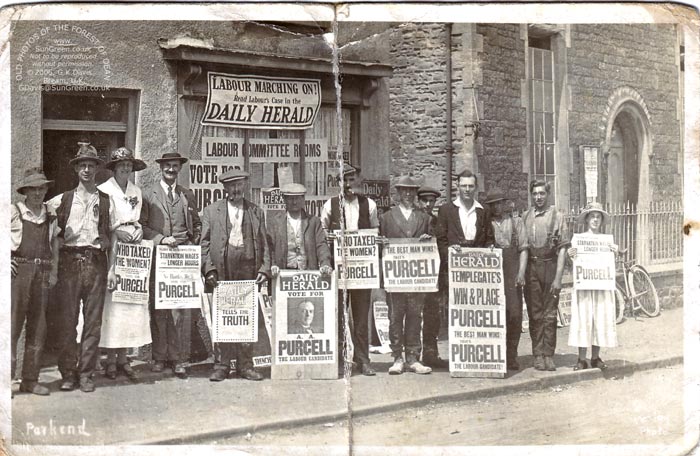
The Forest of Dean Labour Council decided to back Alf Purcell. The local Miners Association welcomed Purcell’s nomination and its Agent, John Williams, shared political views with Purcell and the two men became close friends.
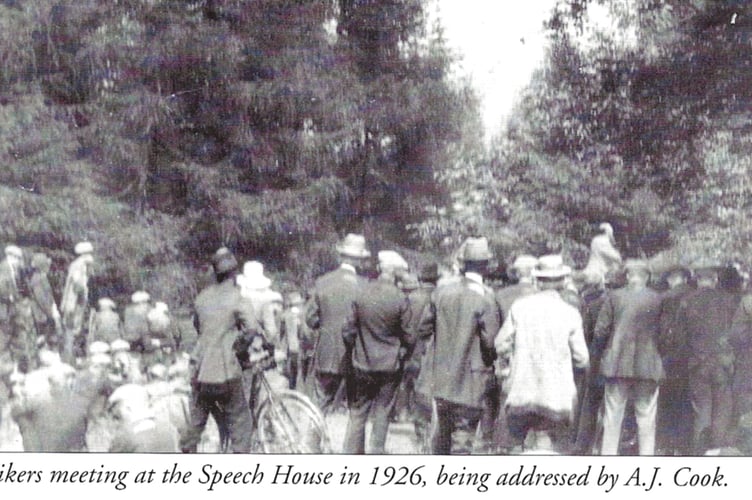
On 11 July 1925, during the election campaign, Purcell spoke to the Annual Meeting of the miners that attracted around 10,000 people at Speech House.
Purcell was elected and carried shoulder-high when the result was declared in Newnham.
Victory celebrations took place across the Forest. A big crowd assembled in the Co-operative Society’s field off Dockham Road in Cinderford. There were events in Ruardean and Lydbrook. A procession of 300-400 people marched from Broadwell Bridge to the British Schoolroom in Coleford.
Determined to be close to his constituents, Purcell and his wife rented accommodation in Latimer Lodge, Littledean Hill Road, Cinderford.
Just as Purcell was elected, the coal crisis was coming to a head. Government subsidies were about to end and coal owners threatened to post notices to cut wages and increase hours.. The miners knew they couldn’t fight alone but their new leader, AJ Cook, agitated for action. Cook had left a troubled childhood in Somerset to move to South Wales where he became a miner and active in left-wing politics.
The so-called ‘Triple Alliance’ of rail, transport and mining unions had failed to aid the miners on ‘Black Friday’ in 1921. This time the threat of a boycott of coal movements worked and the Government, ill-prepared for a major confrontation, offered subsidies to the mine owners until 1 May 1926. The day was declared ‘Red Friday’.
At the TUC, Walter Citrine, acting General Secretary, was not jubilant. He knew this was just a postponement and wanted unions to prepare for action.
The role of the TUC
The Trades Union Congress had been established in 1868 to convene some 1,100 different unions representing every trade and occupation. Ernest Bevin led the big Transport and General Workers Union. The TUC General Council relied on consensus, but some key unions had paid it little attention. Bevin only joined in 1925 and the two miners’ representatives didn’t attend.
Walter Citrine was appointed TUC Assistant General Secretary in 1924. A pragmatic, and brilliant administrator he took a wider strategic view of the union movement. He had been in the job little more than a month when he found that a government committee had been appointed to secure food supplies in the event of a dockers’ strike. He foresaw wider conflict coming and urged unions to prepare.
Government was making plans to deal with a strike. The Government set up Civil Commissioners in ten divisions to deal with transport, food supply, postal services and coal in the event of a strike. The Forest of Dean was in the South West headed by the Rt Hon James, Earl of Stanhope. The secretive Organisation for Maintaining Supplies was working on contingency plans. Preparations could be seen in the Forest of Dean with coal stocks being built up at Lydney Power Station.
The notion of a ‘general strike’
The Left believed that if all workers stopped work it would be unbeatable and the government would have to conceded it demands or fall. Some believed it would herald a revolution.
But amongst union leaders here had been limited discussion about the nature and duration of such a strike. Most assumed that it would be a short-lived ‘demonstration strike’, perhaps a day or two. Bevin was dismissive of such an idea pointing out that half of industry closed on bank holidays without dislocation.
The miners
Forest of Dean miners were amongst the lowest paid in the country.
John Williams had taken on the job of Agent for the local miners in the aftermath of the long 1921 lock-out. The dispute had left the miners defeated and Williams took on to rebuild the union, touring the Forest, representing them regarding accidents and compensation, recruiting new members and constantly urging collective action.
Like Purcell, Williams was a Communist but recognised that the Labour Party offered the best chance of political change. In May 1925 in Comrades Hall in Newnham, Williams was elected President of the Forest of Dean Labour Party.
On 10 October 1925, Walter Citrine was summoned back from a delegation to Russia as his boss, Fred Bramley had died.
Not a penny off the pay, not a minute on the day
AJ Cook’s slogan became the rallying cry for miners as they anticipated the coming confrontation. Government subsidies were about to run out and the owners would cut pay and increase hours. Purcell and Williams held meetings all over the Forest of Dean declaring the determination of the miners to oppose pay cuts and how the wider trade union movement would stand with them.
Williams highlighted the need to wider solidarity action:
“If the miners were to retain their national agreement, their hours and their present wages, the General Council of the trade unions must declare that if the miners stopped, they must stop too.”
Union leaders were still hoping for a last-minute settlement.
Over the weekend at the end of April 1926, Citrine and Bevin worked hard to find a resolution. Neither wanted a strike but both would do their best to lead it to a successful outcome if it happened.
A mass meeting was held in Coleford Cinema on Sunday 1 May. A letter was read from Purcell:
“We are all confident that we shall win for the miners the victory they deserve. We are making history – brilliant history – wonderful pages in the great volume of the life of the world working class movement. Stand firm and enable us to strike the hardest blow of our time.”
The Tory, Lord Birkenhead is claimed to have said that he thought the miners’ leaders were the stupidest men in England until he had the occasion to meet the mine owners.
The Government declared a State of Emergency. When print workers refused to handle an article in the Daily Mail declaring the strike to be a “revolutionary movement” the Prime Minister broke off negotiations and went to bed. This left the General Council with no option but to call the General Strike.
The General Strike
It wasn’t actually an all-out strike. Telegrams were despatched to those unions decreed to be in the first wave of action: transport, railway, power and printing workers. Bevin believed it best to hold back reserves so that phasing the strike could maintain momentum.
Sectors were chosen with the most immediate impact but there was confusion – power workers could not stop electricity to factories and keep hospitals going! Some unions had members in and out. Some workers stopped work even though not called out while others refused to strike.
Overall, the response to the strike call was an incredible act of solidarity.
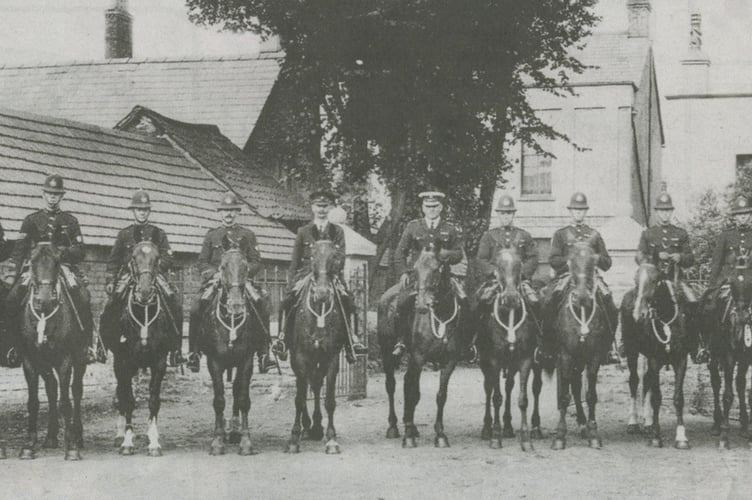
The Government recruited thousands of volunteers to help break the strike. Some enjoyed the fun of trying their hand at the mysterious jobs of the working class. Trains were derailed all over the country when volunteers tried to run them. At least four people died in train crashes during the strike.
The public listened to the BBC for news. It was a critical test for the young private broadcaster. Winston Churchill could see that radio was a more immediate medium in the chaos of the strike, and he lobbied Prime Minister Stanley Baldwin to take over the Corporation.
The Labour Party and the TUC criticised the BBC for refusing airtime to their representatives or voices critical of the Government – including the Archbishop of Canterbury and Opposition leader Ramsay MacDonald. Unions felt the BBC had become a government information service.
The Government seized newsprint to produce its own newspaper The British Gazette. Baldwin put Winston Churchill in charge, a role he enthusiastically took on. Churchill had limited journalistic experience but it kept him busy constantly interfering in the production.
The British Gazette and the limited editions of other newspapers focused on the threat to constitutional democracy and how the strike was a revolutionary act led by communists. The Daily Mail was printed in Paris – complete with French adverts. The Times was a single page set on a typewriter and produced on a hastily installed duplicating machine.
The TUC responded by producing The British Worker but it lacked the means to produce and distribute copies anywhere near the reach the government had.
The cooperative Gloucester Printers set up in 1922 by blacklisted union leader Shirley Bliss, offered the use of its equipment. Volunteers from the local Typographical Society produced the Gloucester Strike Bulletin.
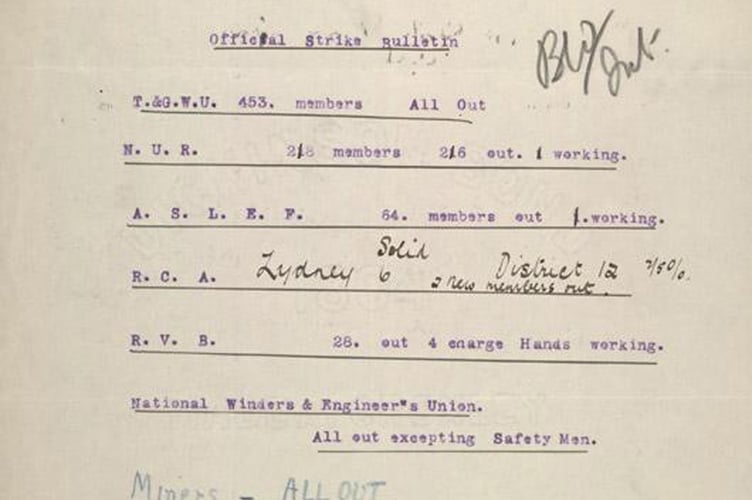
Local Trades Councils became centres for coordination, some turning into Action Committees. They mobilised pickets, issued food permits and organised entertainments. task. In the Forest of Dean a Joint Strike Committee was formed in Lydney. Chairman G Powell and Secretary HW Vaughan reported to the TUC:
T&GWU 453 members all out
NUR 218 members – 216 out, 1 working
ASLEF 64 members out 1 working
Railway Clerks Association Lydney solid
RVB 28 out, 4 charge hands working
National Winders and Engineers – all out except safety men
Miners – all out
In 1926, the Forest was criss-crossed with railway lines and the strike was soon felt. Milk churns were left uncollected as well as other goods. 600 tinplate workers downed tools in Lydney.
The Gloucester Strike Bulletin reported the miners in the Forest of Dean: “Locked out to a man. All is quiet. Miners are organising games and matches. Cinemas are full. Concerts are being got up. Stone workers solid to a man.”
In football, Forest of Dean strikers beat Gloucester strikers 3-0 on the Co-operative Field on Sisson Road in Gloucester.
On Friday, May 7, Gloucester Shire Hall was packed to hear Purcell give an account of the General Council’s attempts to reach a settlement.
“The villains of this piece behind the scenes were Mr Churchill, the tin-Napoleon, Lord Birkenhead and the Chamberlain brothers. They were determined to smash the trade union movement.”
He finished his long address to long and loud applause declaring:
“They were not going to allow the miners to be beaten to dust again. Let them keep cool heads and they would win through for the miners and for the workers of this country.”
The General Strike was to last nine days – see next weeks’ edition to discover how it ended and how the Forest of Dean miners fought on for another nine months.
Comments
This article has no comments yet. Be the first to leave a comment.