

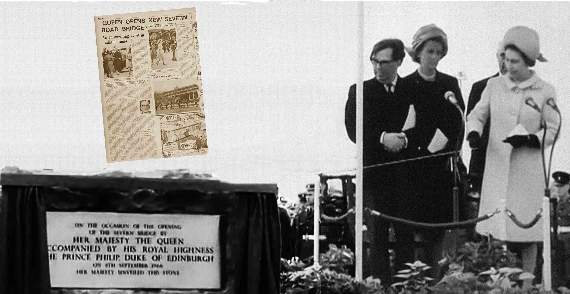
WHEN it was opened by the Queen, 50 years ago today, September 8, The Severn Bridge was hailed as one of the engineering wonders of the world.
Her Majesty also said it was the birth of an economic renaissance for South Wales.
It had taken three years and, at the time, a jaw dropping £8 million to build.
But like most major civil engineering project, the bridge had been hovering in the wings for more than 100 years.


It was first mooted back in 1824 by the great Scottish engineer Thomas Telford who had been tasked with the job of improving mail coach services between London and South Wales.
However the rapid expansion of the railways over the next few decades ensured that the plan was shelved, especially with the opening of the Severn Railway Bridge at Sharpness in 1879 and the Severn Tunnel in 1886.
The road bridge project was hauled out of retirement and dusted down in the 1920s with Gloucestershire and Monmouthshire County Councils jointly promoting a Parliamentary Bill to obtain powers to build the bridge over the estuary.
This was kicked out by Parliament after opposition from the Great Western Railway Company, ever fearful for its profits.
After the Second World War, plans began to be made for a nationally funded network of trunk roads, including a Severn Bridge.
However, because Government funding was prioritised for the similar Forth Road Bridge, opened in 1964, construction of the Severn Bridge was not started until 1961.
The UK government announced in 1962 that construction costs would be ’recovered’ by means of a toll of 2s 6d (12½p) on all vehicle crossings, though walking or cycling across the bridge would be toll-free.
The Forester’s predecessor, the Lydney Observer, went to town on the opening ceremony with a coverage measured, not by the column inch but by the square yard.
The colour and cut of the Queen’s orange and white outfit were given as were the details of her entourage.
The cast included Transport Secretary Barbara Cantle, the 10th Duke of Beaufort, the Archbishop of Wales, an armed guard from the Gloucestershire Regiment, a phalanx of trumpeters and a gaggle of VIPs and civic dignitaries.
Comments
This article has no comments yet. Be the first to leave a comment.