
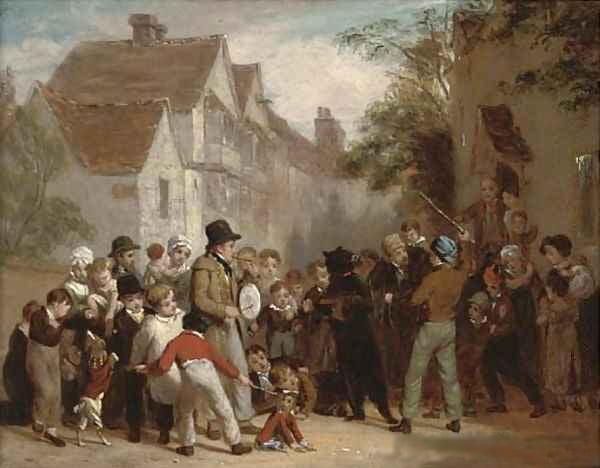
THE killing of two bears at the end of the nineteenth century fuelled a literary legacy in poems, stories, and screenplays.
Local historian, Roger Deeks considers how this was woven into a story that was retold in many forms and gave rise to the darker reputation of the Forest.
The Forest of Dean has generated an identity rich in stories and myths. The killing of the bears has informed a key part of the Forester identity, both inside and outside the Forest.
The full version of Roger’s article is in the latest New Regard, the journal of the Forest of Dean Local History Society.
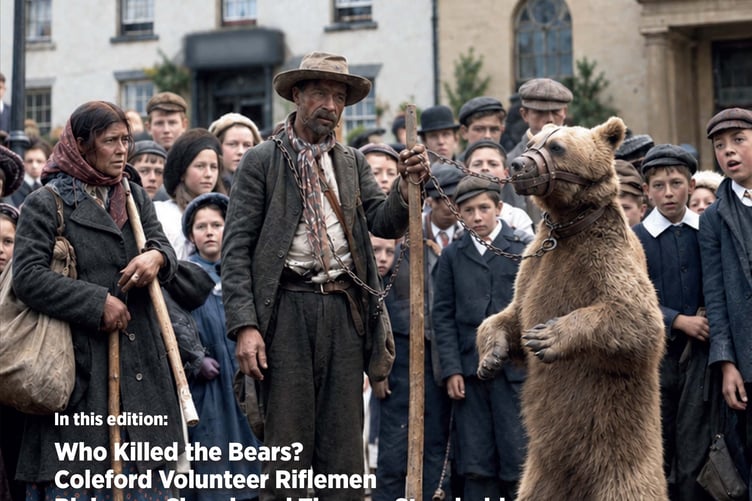
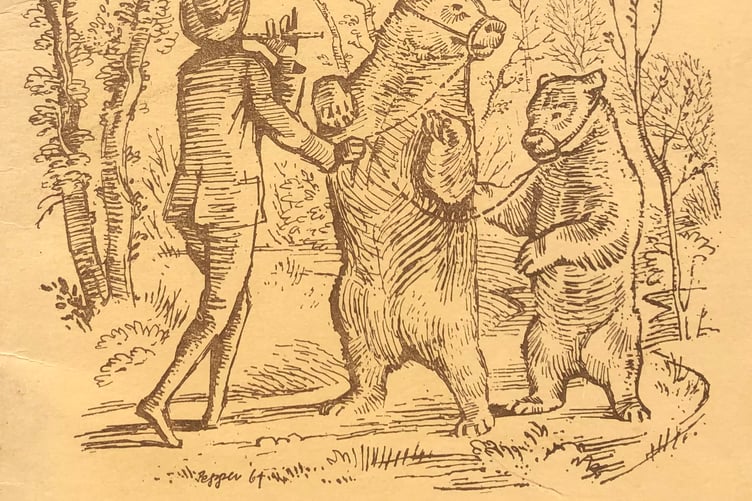
On 26 April 1889, four Frenchmen and their two performing Russian black bears touring the Forest of Dean, arrived in Cinderford.
The muzzled and chained bears performed their way around the town entertaining audiences.
By the time the bears arrived at Nailbridge en route for Drybrook and Ruardean, a rumour was circulating that the bears had killed a child and mauled a woman.
This rumour was taken up by men in the many public houses in Cinderford. A large crowd chased and harassed the bears and their keepers from Cinderford to Ruardean. The Frenchmen and their bears were abused, shoved and beaten with stakes and stones.




Two of the Frenchmen seeking shelter, hid in the woods. As they approached Ruardean, one of the bears was killed. The other bear got nearly as far as Marstow Farm, on the way to Ross-on-Wye, before it was shot. Two of the Frenchmen were taken into care by the vicar in Ruardean.
None of the Frenchmen could speak English and could not understand their tormentors nor make themselves understood.
The police were called, and arrests were later made. Fourteen colliers and labourers were put on trial at the Littledean Court on 3 May 1889.
They were charged with ill-treating, torturing and maliciously killing two bears and assaulting Gabriel Yas and Gabriel Huguet.
The people of Ruardean protested their innocence and appealed in the press not to be labelled as the village responsible.
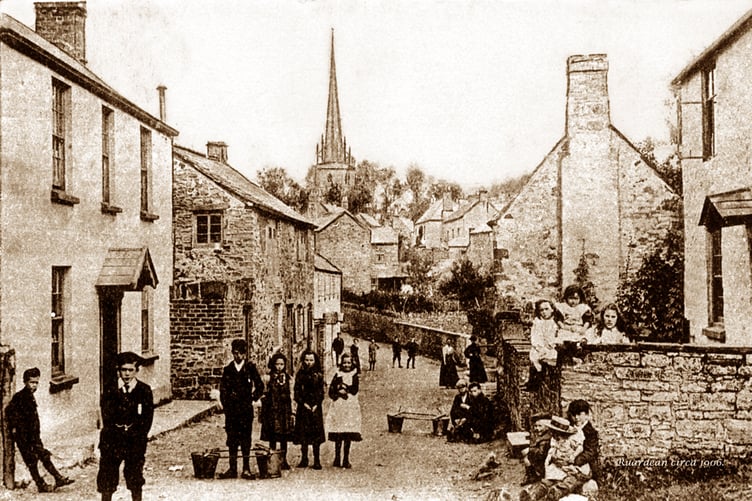
Villagers had a reputation for chasing out of the village anyone they considered a threat or unwelcome. The intriguing question is why this event has lingered in the public consciousness.
No people were killed, and the death of two ‘foreign’ bears was hardly a capital crime. The stoning to death of William Morris, a police sergeant, and the wounding of another by a group of men, six years later and a few miles away, is largely forgotten.
Parts of the answer to the question, lie in the context of the bear-killing crime, the furore that followed and the uses to which the story was put.
The incident was widely reported across the country: “The attack upon the unfortunate Frenchmen and their dancing bears in the Forest of Dean is a disgrace to Gloucestershire and to England.
It recalls the times when England was so held by insular prejudices that it was not the asylum of the proscribed, and not the land on which to-day the whole world looks upon as an asylum.
Luckily General BOULANGER is in London, and the Frenchmen are busy celebrating their Republic and opening their Exhibition.
Otherwise the harrying of these luckless foreigners by the savages of Dean Forest might have gravely complicated international relations.”
Georges Ernest Jean-Marie Boulanger, nicknamed Général Revanche, was a French general and politician who fled to Britain in April 1889 after being charged with treason by the French government.
Britain did not wish to be directly involved in the Boulanger crisis but wished to appear friendly to all things French.
The bear killings and abuse of their French handlers happened just when Britain wished to show itself as hospitable and a place of refuge.
Recent reforms had given many Foresters the right to vote. This was resented by the middle classes who feared a change in the social order and had argued that Foresters and others living outside of towns were particularly savage and uneducated and therefore undeserving of the franchise.

The bear killings and riotous behaviour were portrayed as examples of this.
The fines and public collections in aid of the Frenchmen were given to them as compensation and exceeded the £72 10s that had been paid for the valuable bears.
Part of the public outrage might have related to the cruel killing of the bears, but the financial loss dominated the commentary.
At the end of the 18th century, ‘montreurs d’ours’ or itinerant entertainers, travelled from town to town in the Pyrenees, with trained bears that performed tricks for public crowds.
When bear cubs were caught the mother was killed which decimated the breeding bear population.
Dancing bear troupes were legal at the time of the Forest bear killings. They were banned in Britain in 1911 under the Protection of Animals Act, which criminalised the cruelty involved.
The cubs had been trained to dance through behavioural conditioning, playing music when they stood on red hot coals until the music alone instigated the foot hopping that was deemed to be dancing.
In 1883 a Society for the Protection of Animals inspector successfully prosecuted two Frenchmen for cruelty to their bears.
The case rested on the violent way nose rings were wrenched and the awful conditions in which they were kept.
Who killed the bears?
In the Forest the incident became a source of bitterness in the local community. This rested on disputed responsibility for the attack and the deep offence caused to Ruardean.
The story became a slur on their reputation, not least because they had provided sanctuary to two Frenchmen who reached their village.
As early as August 1890, the taunt ‘who killed the bears?’, became an incitement to argument and fighting. It was first recorded as being used by John Shields, known as ‘Six Fingered Jack’, an itinerant older black American who had been a slave in the United States. He travelled the South-West begging for cash and subsistence.
He reportedly used the taunt to start a ‘disorder’ in a Cinderford pub as a means of getting a seven-day custodial sentence.
The taunt, ‘who killed the bears’ eventually became attached to the village of Ruardean as a prelude to trouble. There are anecdotal stories of gypsies travelling through the village having their caravan upturned for using the taunt.
However, it was generally part of the Forest sub-culture where competition between villages often provoked fights on and off the playing fields or outside boxing rings.
In 1930, Mr Frank Hodges, previously the General Secretary of the Miners’ Federation of Great Britain opened the Cinderford Welfare Hall and Institute and remarked: “there was an idea that the Forest of Dean was a little place tucked away somewhere in the west of England – and was a country of wild bears.
He remembered when he was here hearing ‘who killed the bears?’. He did not know if they had lived that down in the course of the last 30 or 40 years?”
The events and its legacy were again brought to the national conscientiousness by the Gloucestershire poet FW Harvey.
He is remembered as a War Poet but was also a broadcaster and deeply interested in folklore of the Forest. He incorporated the reaction to the taunt ‘who killed the bears’ in his masterpiece The Warning.
The poem is a homage to the character of Forest villages, their folklore and humour.
It was read by Harvey on the BBC in 1935 and was part of a celebration of the Forest. Harvey’s message concluded with an epitaph to strangers who used the term ‘who killed the bears?’ in Ruardean without appreciating the consequences.
The story was seized upon by John Moore in his novel The White Sparrow published in 1954. Moore used the story to fictionalise a confrontation in Ruardean.
The leading character is a boy of mixed race who persuades his black father to take him on a trip to Ruardean where the people were “fierce and strange and wild and free”.
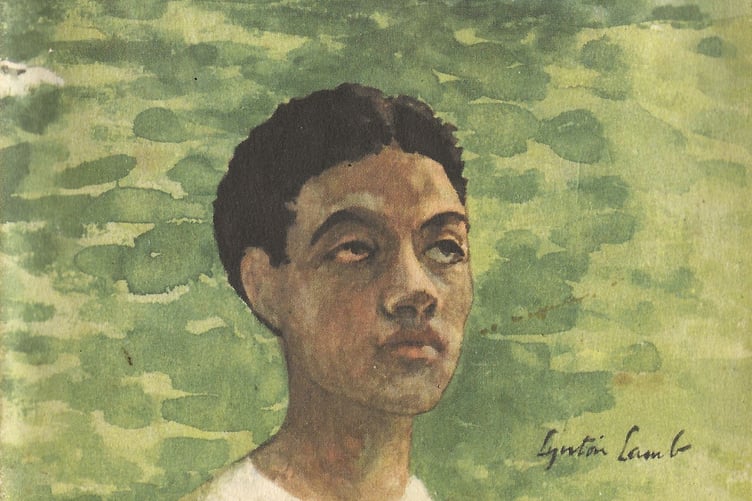
They enter a pub in Ruardean and encounter the nearly drunk miners with their “black faces and gollywog eyes”. The boy remembers his teacher’s assertion that they didn’t like strangers in Ruardean.
The miners accused them of being “two dirty niggers trying to pick a fight”. The riposte from the father was to ask “who killed the bears?”, and a brawl followed.
Harry Beddington, inspired by Harvey, produced a book called Forest of Dean Humour, in 1961 including a poem, Who Killed the Bears? one of the most popular of all his output.
A dialect poet and humorist, Beddington concentrated on the feelings of the misjudged Ruardean people and their propensity to react badly to being taunted by the question ‘who killed the bears?’.
The Frenchmen were described as “Zum vurriners vram ‘cross the sea”, placing them in the category of aliens.
In 1964 Who killed The Bears? by Leonard Clark, a protégé of FW Harvey, was published. Clark was brought up in the Forest and left to become a teacher, school inspector and widely-published poet and author.
In 1964 he produced a pamphlet that retold the story and formed a defence of the Ruardean people. In it he concluded:“It was the township of Cinderford which produced the men responsible for killing the bears”.
Such rehabilitation was pointless because by then it was part of the fabric of the Forest to see Ruardean folk as for ever both responsible and resentful.
More crucially he concluded: “It is a horrible story. I was brought up in the Forest and I am ashamed to tell it.”
The retelling of the story gave it a renewed importance in the formation of Forest identity in the second half of the twentieth century.
A consequence of Clark’s work was an ATV television news item featuring journalist Lionel Hampden outside the Malt Shovel pub in Ruardean talking to Thomas Thompson, the last living eyewitness, who blamed Cinderford men for the incident.
Beast with Two Backs
The story and its meanings were taken to another level with the broadcast of a Dennis Potter play, A Beast with Two Backs, in 1968.
There was discomfort in Ruardean even before the drama was recorded. A BBC producer arranged for the bear to be used in filming to be kept in accommodation at Ross-on-Wye.
He cancelled the bear lodgings, writing: “It seems that our filming this story has genuinely stirred up considerable agitation in various quarters, because of the incident that happened so many years ago in Cinderford.
In consequence, we feel that it might be wise to keep the bear in a rather more protected place – also we would hate to expose you to any unpleasantness.”
Potter reinvented the story and employed it to address multiple issues of sex, death and religion and recast the bear handler as a hapless Italian.
It was the first of Potter’s plays to be unambiguously set in the Forest of Dean. In the script the provocation of the crowd to attack the bear was based on the actual incident, the supposed mauling of a child.
The chapel community and its fictional leader came out of the story badly. In the actual events of 1889, it was the intervention of the local Anglican vicar that is attributed with preventing the attack descending into something worse, and his ability to speak French offered some reassurance to the two bear handlers.
The taunt would provoke a brawl in public houses within the Forest and particularly Ruardean until the end of the twentieth century. Forest rugby teams playing anywhere in Gloucestershire were regularly provoked by the taunt.
Humphrey Carpenter, Potter’s biographer, whose view of the outlook of Foresters was: “’Foreigners’ were regarded with hostility, while the outsiders themselves thought it a strange place, with wild ways; across the Severn in Bristol they joked that the Foresters were so intermarried that they were half-witted.
“There were reports of policemen being murdered, and it was said that in 1889 the villagers of Ruardean became so worked up by the spectacle of two dancing bears, displayed by a band of Frenchmen, that they hit and stoned them to death, and the owners were lucky to escape with their lives. As late as 1905, a woman was accused in court of being a witch.”
The story of the bears is now an integral part of the Forest identity. ‘Who killed the bears?’ is a source of amusement rather than a provocation. Well, almost.
Comments
We've recently changed our login process. If you have an account for commenting, you will need to re-register on the login window.
This article has no comments yet. Be the first to leave a comment.