
AN ORDINARY walk through woodland near Brierley in the Forest of Dean has led to an extraordinary archaeological discovery, after a Bronze Age axe head was discovered embedded among the roots of a fallen tree.
Forest local, John Smith made the chance find while exploring the woodland. Realising it could be something significant, he immediately reported it to Forestry England, who manage the site. The object was carefully recovered and transferred for formal recording and expert assessment.
Forestry England confirmed the artefact was in stable condition and arranged for specialist evaluation, with Cotswold Archaeology brought in to assist with identification and conservation guidance.




Community Ranger Leoni Dawson said: “It’s incredible to think that tools like this have survived for thousands of years, hidden beneath our feet. Finds like these help us connect with the people who lived and worked in these landscapes long before us.”
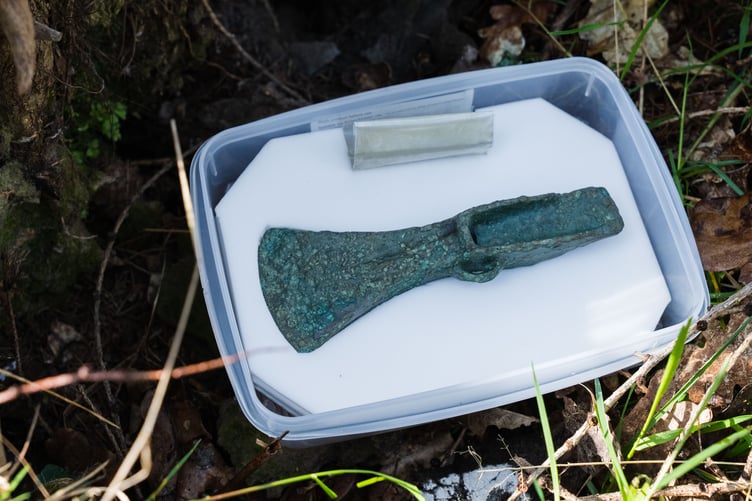
Initial examination identified the object as a palstave axe head, dating to the Middle Bronze Age. These tools were widely used across Britain between around 1,500 and 1,000 BC and represent an important development in prehistoric metalworking.
Objects Conservator Kayleigh Spring explained the technical detail behind the artefact: “Known as a Palstave Axe, it is made from a copper alloy, most likely bronze, a mix of copper and tin. This tool was originally cast in moulds. Early Bronze Age moulds were simple hollowed stones, but by the Middle Bronze Age, two-part moulds allowed for more sophisticated designs like this one.”
Following conservation, the axe head has been transferred to the Dean Heritage Centre, where it will be documented, preserved and cared for as part of the Forest of Dean’s historic collection.
The discovery has also been recorded in a virtual museum by Cotswold Archaeology, allowing wider public access to the find and its significance in understanding prehistoric life in the region.
Comments
This article has no comments yet. Be the first to leave a comment.