
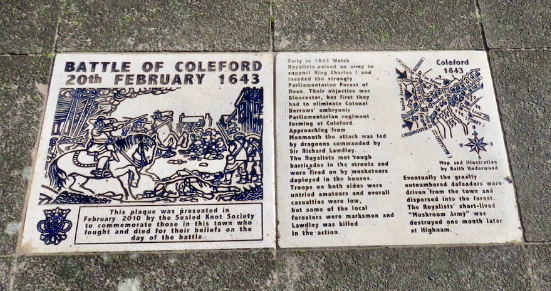
I’ve just discovered a memorial in Coleford, to the start of the Civil War in the 1640s Civil War. I had always thought that the Civil War was an English affair, with Royalists, led locally by Sir John Wyntour (there are various spellings of his name) and the austere Roundheads, led by Colonel Massey from Gloucester. But Coleford was host to an invasion by Welsh royalists early in the Civil War.
There were several key events in that local conflict. Newnham Castle was one of the Royalists’ strongholds, with the river on one side and strong defences on either side, but the Roundheads, rather unsportingly, attacked from the rear, and Wyntour was defeated. Wyntour was not noted for his military acumen, and was not able to trouble his Roundhead enemy, but he managed to flee from the Roundheads as they mopped up the Forest for the Roundheads, by galloping off to Lancaut and slithering on horseback down the high slope from the high cliff down to the waiting boat below, waving to the frustrated Roundheads above as he sailed off.


I thought that the Severn was the main area of military action in the Forest of Dean during the Civil War. But I had missed the Battle of Coleford. In the early days of the civil war, on 20th February 1643, some royalists from Wales, known as the ‘Mushroom Army’, under the leadership of Sir Richard Lawley, overwhelmed the makeshift Coleford irregulars. But the progress of the royalists was brought to an end by their comprehensive defeat at Highnam a month later.
At the beginning of the Civil War, Wyntour’s allegiance to King Charles was expected, but he did not confirm this until the siege of Gloucester. In 1642 he tried to send cartloads of armaments from his residence at Lydney to Gloucester to support any royalists there, and the following year fortified his house against attack. Following the capture of Gloucester by the Parliamentarians, he had ongoing battles with Colonel Massey, the governor of Gloucester, as they chased each other up and down the Severn, burning each other’s churches. Massey was a poor soldier and lost every battle but always managed to escape. Sir John Corbet, in his contemporary account, An Historical Relation of the Military Government of Gloucester, said that Winter was "wise for himselfe, nimble in inferiour business and delighted more in petty and cunning contrivance than open gallantry..."
His house at Lydney, White Cross Manor, had been fortified. In 1645 he ordered it burnt to avoid it being taken over by the Parliamentarians.
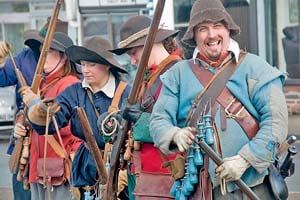
The Sealed Knot charity records and re-enacts key military events in our military history, and their musket fire at the 373th anniversary of the Coleford battle and the plaque at the centre of Coleford highlight the beginning of the 17th Century Civil War.
Comments
We've recently changed our login process. If you have an account for commenting, you will need to re-register on the login window.
This article has no comments yet. Be the first to leave a comment.