
In the Forest, there are two buildings slowly rotting, collapsed, surrounded by barbed wire. They are former places of rest, recovery, hospitality, healing, refuges from the outside world, with connections to a well -known outsider.



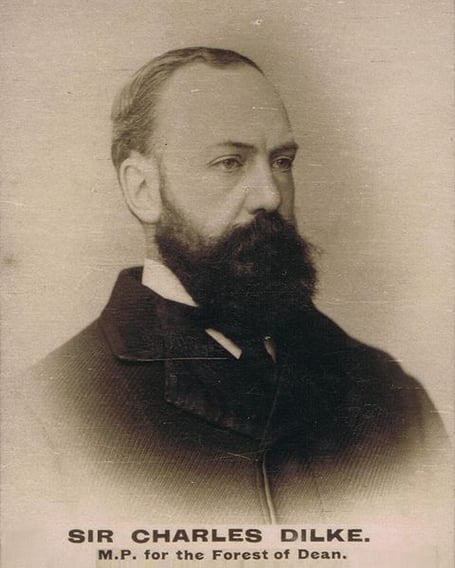
The well-known outsider was Sir Charles Dilke,an important figure in the late nineteenth century, a leading member of the Liberal party, which at that time was frequently the governing party of this country. His political importance and unfulfilled ambition were documented in the biography ‘The Lost Prime Minister: Life of Sir Charles Dilke’ by David Nicholls (1995). He was MP for Chelsea, but after a messy divorce, he was expelled from London society. Many years later it was suggested that the allegations against him were political lies to undermine him and his party, and there io now a plaque in his memory displayed at his home in Sloane Square, Chelsea. He was a rare politician, an imperialist Liberal, and managed to reconcile colonial expansion with welfare for British workers.
But he persuaded the leader of the Liberal Party, William Gladstone, to approve his wish to serve as an MP for a working class constituency, so he became Liberal MP for the Forest, and devoted his political life to improving the lives of people in the Forest, lobbying for improvements in employment law for local workers. He was the Forest MP until his death in 1911. Charles Dilke’s name is always associated with his divorce and adultery scandal, which ended his appearance in London’s high social life, but in the Forest his dedication of this refugee from London social life to the well-being of his adopted constituency is still remembered.
Two of the buildings in the Forest that are best associated with Dilke are the Dilke Hospital (between Cinderford and the Speech House), and the Victoria Hotel in Newnham. The Speech House was his constituency HQ, and his local party meetings would be held there. But in the cold snowy winters of late Victorian and Edwardian England this was inaccessible, so his party meetings would be held at the Victoria Hotel, Newnham, the closest you could get to the Speech House in a horse and carriage (Forest railway lines never reached the Speech House).
But the lowland Victoria Hotel in Newnham has been closed for nearly 20 years and is surrounded by metal fencing. Similarly, the Dilke (Hospital), after the merger of the Lydney and Dilke hospitals, is now the derelict remains of a hundred year old essential medical service for Foresters. But at least there is now a tribute to Sir Charles Dilke at the new Forest Hospital at Cinderford.
But both historic, abandoned Forest buildings are now slowly decaying. Could they please be re-generated, acknowledged, or completely removed?
Comments
We've recently changed our login process. If you have an account for commenting, you will need to re-register on the login window.
This article has no comments yet. Be the first to leave a comment.