

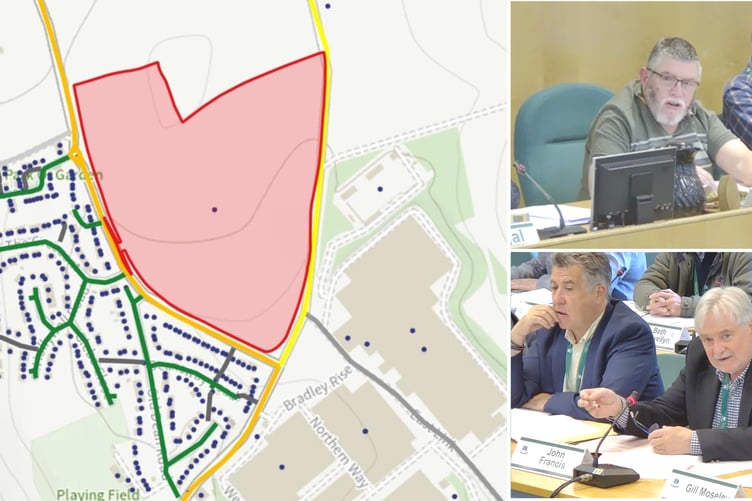
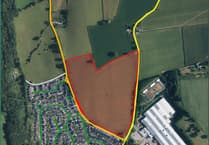
FOREST planners have opted to ask the Secretary of State for Local Government to make a decision on proposals for a 180-home estate.
The size of the proposed estate on the edge of Mitcheldean meant that the Forest Council’s development management committee could not issue a straight refusal.
If a proposal is for more than 150 houses in a “sustainable” location, recent changes to the law stipulate that the presumption should be in favour of granting permission.
The committee was warned that if the proposal for land near Carisbrook Road was allowed on appeal there was a “significant” risk of costs being awarded against the council.


Chair of the committee Cllr Dave Wheeler (Green, Newland and Sling) explained: “We can vote for refusal but we will not be able to issue the refusal.
So if the committee wishes to refuse, we put forward our reasons, which must be good planning reasons, and we pass that decision to the development manager, who will then refer it to the Secretary of State.
“So we can, if we want to, go for a refusal, but we don't have the power to actually make that decision, it would have to be referred.”
The recommendation from officers was that the committee should approve the application by Cheshire-based Gladman.
The committee ultimately voted seven to two with three abstentions not to approve the application.
The reasons included the site being outside the village development boundary and “urbanising” of prime development land.
The council will have to persuade a planning inspector that those reasons trump the presumption in favour.
Potential weaknesses include the fact that the Forest does not have a five-year supply of housing land – a point on which the council has previously lost planning appeals.
The key concerns for councillors included the potential for further traffic jams and that some children would have to be transported to schools outside the village but experts from Gloucestershire Highways and the local education authority did not object to the proposals
As part of the plan, some 72 properties would be affordable with 12 one-bed flats three one-bed bungalows 21 two-bed houses; 11 three-bed houses, two four-bed houses and one five-bed house for social rent.
There would be 11 two-bed houses and 11 three-bed houses for shared ownership as well as self-build plots.
There are currently 193 households on housing register seeking affordable housing for rent in Mitcheldean, of which around half need one bed accommodation.
There is also an acute need for larger family housing, a report said.
All but one of the 298 comments received by the council objected to the plan.
Addressing the committee, Lee Cartwright of Mitcheldean Parish Council, said prime agricultural land should not be developed when “brownfield” sites were available.
He said an application for 125 houses on the site was refused by the council in 2019.
“The current proposal has drawn widespread objections, highlighting the village’s limited infrastructure and resources to accommodate a development on this scale.
“This is grade one, agricultural land, supporting two crops per year.
“The district contains plenty of lower grade agricultural land and brownfield sites that should be prioritised.
“The winners are clear: the landowner, the developers, and their solicitors, those set to make huge profits.
But the losers are everyone else: residents struggling for a timely doctor's appointments, families forced to send children to schools outside a Mitcheldean drivers face an increased traffic congestion, those who value the peace and character of our rural village.
“They all lose, along with nature, biodiversity, and the local food chain.
“Our beautiful thriving village would be overwhelmed with little chance of recovery.”
Robert Devon, the agent for the applicant, said the proposal would help meet the housing needs of Mitcheldean and the wider district.
It also included a substantial amount of open space including a play area.
He added: “Our proposals offer appropriate and significant mitigation to ensure there'll be no unacceptable impacts on the local community and infrastructure. “This includes financial contributions of around £487,000 towards education provision and school transport, and approximately £182,000 towards delivering additional capacity at Mitcheldean's surgery.”
Several members of the committee were unhappy with what they saw as being effectively railroaded into accepting the proposal.
Cllr John Francis (Ind, Longhope and Huntley) said: “What’s been illustrated is how powerless we are.
“We can't refuse something which plainly is wrong.
“You've got grade one agriculture land, they’re busing children across the county. “Question marks on sewage, it’s outrageous.
“We are here, as an elected body, to represent the needs and views of our residents and we'll be hamstrung to come to a decision that we really don't want to give.”
Cllr Stuart Graham (Ind, Cinderford East) said legally the application “ticks every box”
“The law, in this sense, is an ass.
“It's not that the residents are saying that we don't want people here.
“It's not NIMBY opposition, there’s other land available, just over the road in the industrial area.
“This is a threshold application – if this one goes through then anything goes.
“We're supposed to be representing the best interests of the residents, and yet we are effectively being required to act as agents of a very unpopular government, and a law that isn't very useful.”
Cllr Richard Burton (Green, Newnham) asked officials if there were realistic and valid planning reasons to refuse the application.
Development manager Clive Reynolds said their report presented the pros and cons, attributed “weight” to each to reach a recommendation of approval.
He said: “Members are fully entitled to reach a different conclusion, but in doing so, they will need to demonstrate that the weight to the negatives outweighs those to the positive.
“Also having regard to the fact that this is a tilted balance, the presumption automatically is in favour of development.
“You've got to come up with a very strong reason to go against the reasons.
“We understand the amount of concern that local residents have to the application but we can't tell you whether you would win an appeal or not.
“I think our professional view is that, as it stands, the arguments aren't strong in terms of a planning appeal.
“Saying there's a lack of school places, when the educational authority have no objection to the development, we'd have to go to a public inquiry, and, as a council, defend why we aren't in agreement with the authority that deals with education because each reason for refusal has to stand on its own right.
“Raising a technical reason for refusal, without a statutory consultee backing your position puts the council in an incredibly difficult position at appeal.
“I recall a case in Drybrook, where members introduced the drainage reason for refusal on a housing development, and we had costs awarded against us because we couldn't supply a technical expert to defend against the technical experts of both consultees and the applicant.
“in the view of your officers, there's a substantial risk of costss at an appeal, if you progress the reasons that you put forward, but it is your choice.”
There were cheers from the gallery when the vote was announced and Cllr Wheeler publicly thanked Principal Planning Officer Emma Hughes for her extensive report.
Comments
This article has no comments yet. Be the first to leave a comment.