
FOREST of Dean MP Matt Bishop has welcomed a government decision to hand over documents relating to Lord Mandelson’s appointment and the Jeffrey Epstein files to Parliament’s Intelligence and Security Committee, describing the move as a vital step in putting victims at the heart of justice.
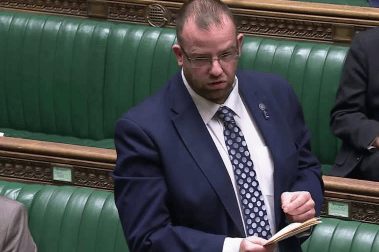
Mr Bishop said the decision followed his speech in the House of Commons, where he called for greater transparency and accountability amid growing concern over how Lord Mandelson, a former US Ambassador, was vetted in light of his past associations with Epstein.
Speaking after the announcement, the MP said it was “essential that victims are put at the heart of justice, without exception,” adding that he would continue to advocate for survivors to ensure their voices were heard “every step of the way, in every circumstance”.
In a wide-ranging and emotional contribution in the Commons, Mr Bishop made clear that his intervention was not an attack on the government, stressing that he remained proud of its record so far.



He pointed to major investment in the NHS and schools, action to reduce inequality, measures to support families during the cost-of-living crisis, and renewed ambition in tackling violence against women and girls.
He also referenced a recent cross-party vote to lift hundreds of thousands of children out of poverty, describing it as a moment of genuine progress that had been overshadowed by what he called the “growing scandal” surrounding Lord Mandelson.
Mr Bishop warned that public trust was fragile and risked being undermined if the same standards of transparency demanded elsewhere were not applied to those close to power. He questioned how victims could be asked to trust the system if documents linked to serious concerns about a senior figure were withheld from scrutiny.
Referring to the government’s Violence Against Women and Girls strategy, which he described as one of Parliament’s proudest achievements, Mr Bishop said its credibility depended on consistency and openness.
The MP also highlighted concerns raised by the recent release of Epstein-related files, which he said reinforced fears about elite networks operating close to power and shielded by status and influence. Without transparency around vetting decisions, he warned, victims may feel discouraged from coming forward.
Drawing on his own constituency experience, Mr Bishop spoke of meeting survivors and working with organisations such as the Hollie Gazzard Trust. He said he could not, in good conscience, support any move that might conceal the behaviour or relationships of powerful individuals.
While acknowledging government concerns around security, reputation and diplomacy, Mr Bishop argued that these could not justify silence if vetting decisions were compromised.
He called for independent scrutiny rather than internal reviews, asking how government could “mark its own homework” on issues of such gravity.
Concluding his speech, Mr Bishop said that while opposition motives may be political, this did not remove the government’s responsibility. “I am voting with the victims, I am voting with the survivors,” he said, “and I am voting for the principle that no one, however powerful, should ever be beyond scrutiny.”
Comments
This article has no comments yet. Be the first to leave a comment.