
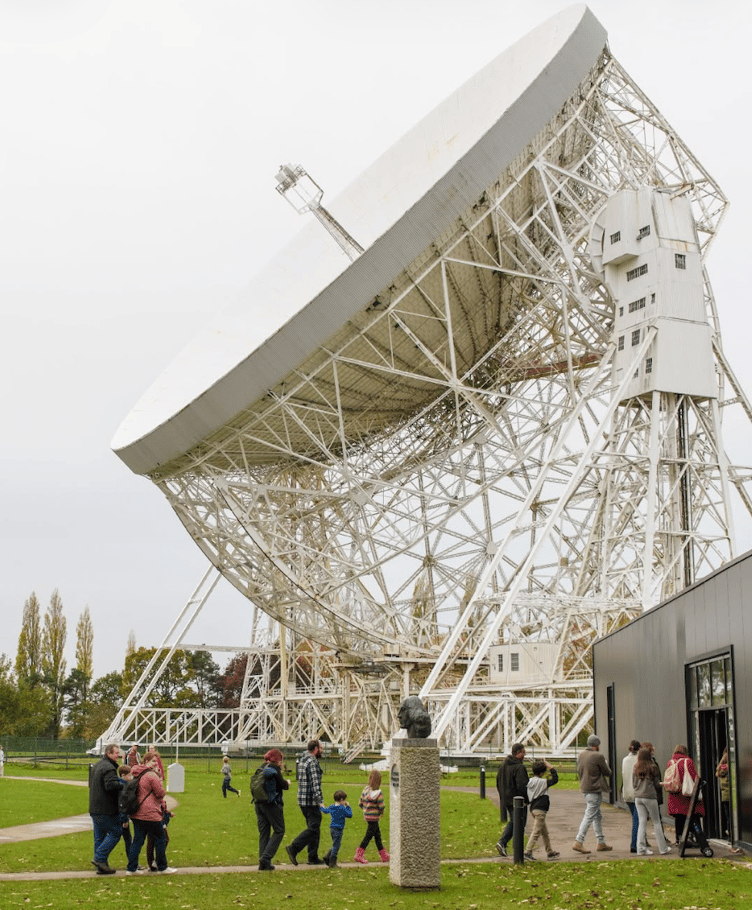
THE life's work of a famous scientist who narrowly escaped a fatal Wye Valley plane crash in WWII could be scrapped over a funding crisis.
Having given up his seat on a secret radar research flight that crashed on the Courtfield estate between Lydbrook and Welsh Newton, killing six scientists and five crew, Sir Bernard Lovell later went on to set up and run the Jodrell Bank radio astronomy observatory in Cheshire.
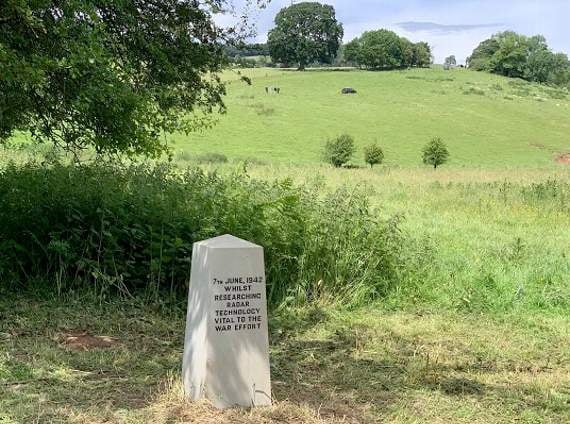
Those killed in the June 7, 1942, disaster below Coppett Hill included his close friend Alan Blumlein, the inventor of stereo sound, who was awarded a posthumous Grammy in 2017.
And the physicist, who gave up his seat at the last minute and was affected by the tragedy for the rest of his life, had the harrowing job of searching through the wreckage beside the River Wye to recover parts of the H2S radar cavity magnetron, which proved vital to the war effort.
At the end of WWII, Sir Bernard founded the world-leading space observatory in Cheshire, featuring the UK's largest telescope, and continued to run it until 1980.
But Jodrell Bank and the iconic Lovell telescope, named after him, is now facing the axe owing to funding cuts.
The UK Research and Innovation (UKRI) agency, which funds it to the tune of £2.8m a year, said it had to focus investment on projects that deliver "the greatest long-term impact".
But scientists have slammed the decision to close it in April 2028, with TV star Brian Cox, professor of particle physics at Manchester University which hosts the observatory, calling the cuts "hasty and ill-considered".



"The damage to the UK's science base has already been substantial. I am astonished that UKRI are still ploughing ahead and not working with the Burnham government to find a solution," he said.
The observatory has enabled the study of distant galaxies and trained future astronomers for decades, and also played a pivotal role in the Cold War monitoring Soviet missiles.
Jonathan Reynolds, the new Secretary of State in the expanded business department that oversees science, told BBC News the country's world class research sector was "absolutely central to creating a better future for the UK".
"I am committed to working with UKRI to ensure the UK remains able not only to sustain its world-leading research capabilities, but also to invest in the next generation of scientific facilities and infrastructure that will underpin discovery, innovation and growth in the years ahead,” he said.
Prof Simon Garrington, Jodrell Bank associate director, said everyone at the observatory was "devastated" by the decision.
"It's not just because of the fantastic science that we do, but Jodrell Bank and its telescope network [have been] a national capability for nearly 70 years and a beacon for science in the north-west [of England], attracting young people into science and engineering careers," he said.
The crash of the converted Halifax plane in 1942 was considered so sensitive that Winston Churchill declared it top secret.
A memorial to the 11 men who died was finally unveiled at the crash site in 2019, which was attended by family members and Sir Bernard’s daughter Judy Spence.
Comments
We've recently changed our login process. If you have an account for commenting, you will need to re-register on the login window.
This article has no comments yet. Be the first to leave a comment.