
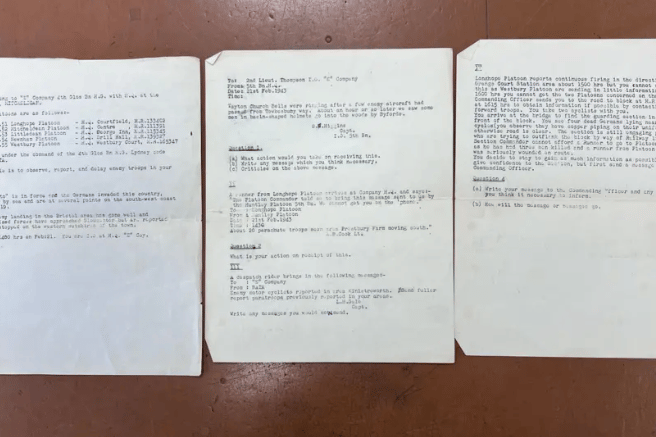
RARE documents revealing how Forest of Dean Home Guard volunteers prepared for a possible German invasion during the Second World War have been discovered in an attic.
The papers, dating from 1943, contain detailed training exercises used by E Company of the 4th (Forest of Dean) Battalion Home Guard, which was based in Mitcheldean.
They were uncovered by Bill Acland at his home in Ruspidge, although he remains unsure who originally owned them or how they came to be stored there.
The typewritten documents provide a glimpse into the challenges facing local volunteers tasked with defending their communities against potential enemy attacks.
Among the exercises is a fictional incident involving four dead German soldiers discovered beside motorcycles at Westbury-on-Severn.
Another describes enemy aircraft approaching from Tewkesbury, followed by reports of suspicious soldiers entering woodland near Byfords after church bells began ringing in Taynton.
A further scenario places Home Guard members in combat with German paratroopers beside the railway at Longhope.
With several men killed and a messenger seriously wounded, the exercise challenges a section commander to decide how best to communicate with headquarters.
The documents demonstrate how volunteers were expected to make difficult decisions under pressure, despite many having no previous military experience.
Local historian Roger Deeks explained that the battalion operated through several companies covering different parts of the Forest.




As the war progressed, their organisation and training became increasingly advanced.
He described the discovery as "real evidence of how they were training people and making sure they understood how to respond to situations".
The Home Guard was established in May 1940, initially under the name Local Defence Volunteers, amid growing fears that German forces could invade Britain.
Its members were primarily men unable to serve in the regular armed forces, including those considered too old or working in reserved occupations.
Although initially hampered by shortages of equipment and uniforms, the organisation gradually developed into a more structured defensive force.
Volunteers undertook military training and carried out duties ranging from guarding important locations to dealing with unexploded bombs.
According to the Imperial War Museum, 1,206 Home Guard members died while serving or subsequently from injuries sustained on duty.
The Forest battalion also maintained a musical tradition, with its band performing during a BBC radio broadcast in Bristol in August 1943.
Mr Acland has now donated his discovery to the Dean Heritage Centre, where the papers will join an existing collection of wartime memorabilia.
He hopes the documents might hold particular significance for descendants of those who served locally.
Explaining his decision, he said the papers "belonged in a museum somewhere" and could help reconnect families with their relatives' wartime experiences.
Nicola Wynn, collections officer at the heritage centre, welcomed the donation, saying it provided valuable evidence of the responsibilities undertaken by local volunteers.
She said the material demonstrated how seriously the men approached their preparations and the variety of threats they were trained to confront.
The documents will be displayed alongside other Home Guard artefacts at the centre during the Remembrance period.
Comments
We've recently changed our login process. If you have an account for commenting, you will need to re-register on the login window.
This article has no comments yet. Be the first to leave a comment.