

Littledean Hall, previously known as Dean(e) Hall, has been described as England’s most haunted house. One story features the ghost of a black enslaved servant, apparently killed after he had murdered his master in revenge for the rape of the servant’s young sister.
The slave and his master are featured in a painting previously displayed at the Hall. In his article in the current New Regard, the journal for the Forest of Dean Local History Society, Steven Carter investigates the black boy’s ethereal legend, what history is involved, and to what extent such enslaved servants existed in the Forest.
This haunting tale comes from the 18th century. Thomas Pyrke, the owner of Littledean Hall, brought a black brother and sister back to the UK from his West Indies plantation, perhaps Antigua, to be personal servants (more accurately, enslaved children) for his young son Charles and a daughter.
In early adulthood, Charles raped and impregnated the black sister. Some accounts mention hiding a baby behind a secret wall panel. When the brother discovered Charles’s deeds, he strangled his sleeping master and escaped the house. Thomas Pyrke quickly had him found and killed.

The Red Boy Painting
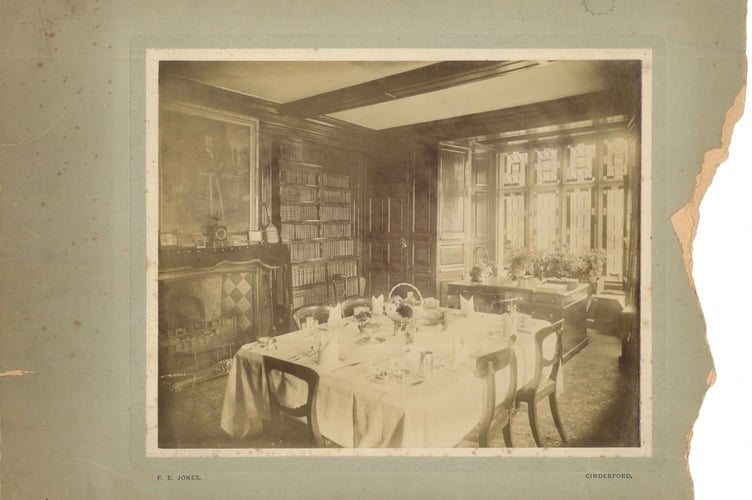
The painting, called The Red Boy, hung in the Hall’s dining room until replaced by a facsimile when the Pyrkes relocated in Victorian times.
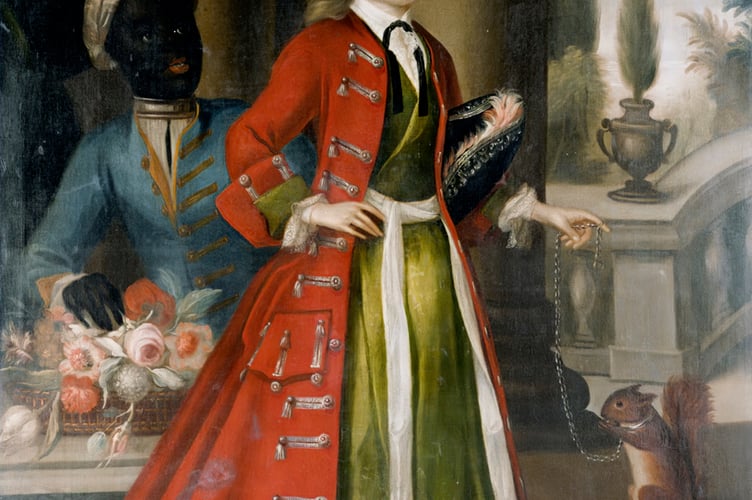
Roger Deeks, currently researching the Pyrke paintings of Dean Hall, identifies the central figure as Charles Pyrke (1720-1744). Assessing Charles at about ten years old would date the painting to around 1730. Deeks has established that John Verelst (1648-1734) painted the contemporaneous Pyrke portraits. Although unable to inspect the Charles Pyrke painting, he attributes it by association and style to the same artist.
The painting’s central figure stands tall in a dazzling red coat meeting our gaze with confident self-assurance. This miniature adult is portrayed amidst classical architecture (not Dean Hall), ready to assume the responsibilities of his superior rank in Georgian society. His tame squirrel, common pets then, may denote qualities like prudence or thrift.
In contrast, the peripheral black boy watches Charles. His decorative silver collar, probably padlocked, and his flamboyant attire, blue tunic and patterned turban signify his young master’s wealth, status and power. Fashionable elite households brought black children to Britain, mainly boys aged under ten, to work as domestic servants. The boy’s posture and alert eyes fixed exclusively on Charles show readiness to anticipate any whim.
For Deeks, items like the classical architecture, tame squirrel and even the enslaved black boy might easily be motifs, potentially copied from books, prints, sketches, or human models.
An earlier Verelst painting features Elihu Yale, family members and a silver-collared black boy. There are striking similarities to the Littledean painting’s black servant.
The Pyrke Family at Littledean
The Pyrkes were a prominent landed family, established at Mitcheldean since the late 14th century, and claiming local residency since the Conquest. In 1664 Thomas Pyrke of Abenhall purchased Dean Hall.
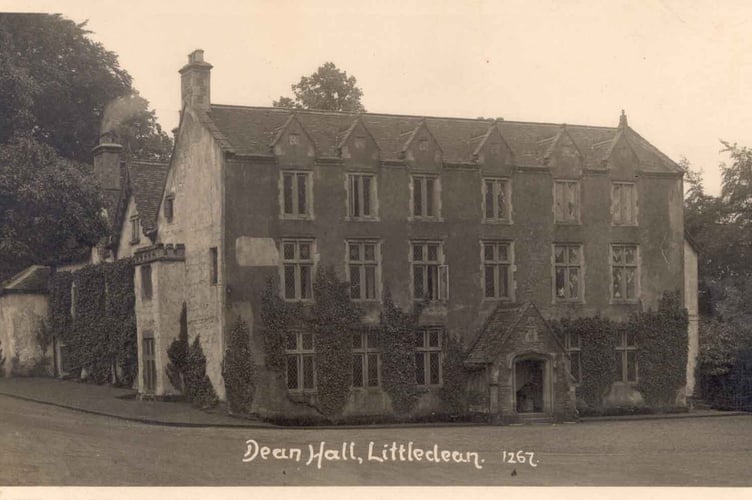
After his death in 1702, his son Nathaniel inherited Dean Hall. Nathaniel (d.1715) favoured the Glorious Revolution, became a Forest Verderer, married Mary Colchester, and added to his estate Cockshoot House and Notgrove, near Northleach. The legend’s Thomas was Nathaniel’s son and heir.
From 1709 Thomas was an early supporter of the Christian Knowledge Society (SPCK), of which his uncle Col Maynard Colchester MP, of Westbury Court and the Wilderness, was a founding member. In 1711 Thomas married and was a member of London’s Middle Temple. Thomas became a JP, Deputy Constable of St Briavels Castle, Verderer and honorary Free Miner. In 1740 he bought and rebuilt the Folly farmstead. His will bequeaths lands and thousands of pounds.
From Thomas (d. 1752) the estate passed to his wife Dorothy (d. 1762). Her memorial in Littledean church describes her “many sore and heavy afflictions for the loss of her husband and six children.”
All six predeceased their parents. When Charles graduated from Balliol in 1740/41, he was perhaps the sole surviving heir. His Littledean inscription confirms he died young, as in the legend, in 1744, aged 23.
Since Thomas discharged his offices “with honour and integrity”, an extrajudicial killing of the black servant seems improbable. Neither is there any record of a murder, a surprising omission, given that in 1744 a servant killing a master amounted to petty treason.
Reports of a newspaper record likely originated from Dean Hall resident William Guise’s claim in 1881, that among county records was a notice of a ‘n---er’ with a silver collar being found straying, and unable to give a satisfactory account of himself, and he (Mr Guise) suggested whether this could have been the guilty black. But this fails: Queen Anne died in 1714, before the painting’s black servant was born.
Without surviving offspring, Dean Hall and its paintings descended to Thomas’s great nephew Joseph Watts, now renamed ‘Pyrke’. When these later Pyrkes left the Hall, they removed all the valuable portraits, replacing originals with reproductions.
Britain’s black population
In 1730, England had a growing black population, mostly male, largely concentrated in port cities like London, Liverpool, and Bristol. Since Elizabethan times, royalty and nobility had black servants and entertainers. By 1768 London had an estimated 15,000 black servants.
In the 1730s, most black people in Britain were ‘enslaved’. Some were free, a tiny few well-educated, and one or two individuals became prominent celebrities. Talented black writers, entertainers, or entrepreneurs helped challenge racist justifications for slavery, that Africans were uncivilised heathens and naturally suited to servitude.
The enslaved Nathaniel Wells was freed by his white father, educated in England and inherited his sugar plantations. In 1802 he bought Piercefield estate (including land now used for Chepstow Racecourse). Despite obvious black skin, Wells was educated and wealthy, fitting into elite society and becoming Britain’s first black High Sheriff.
Exotic and fashionable, mostly servants, some had better livery, housing and food than many white workers.
In 1729 the Yorke-Talbot Opinion clarified enslaved people’s legal status: coming to Britain or being baptised did not bestow freedom; and owners could compel their return to the plantations. This ruling endured until the pivotal case of James Somerset in 1772, when Lord Chief Justice Mansfield ruled that Somerset’s former owner had no right to force him back to the Americas. Mansfield avoided suggesting enslaved Africans in Britain were automatically free, but the case was considered a substantial victory.
From the mid-1780s, anti-slavery voices like Quakers and Thomas Clarkson became better organised, more informed and increasingly clamorous. As enslavers risked attracting social disapproval, fewer portraits appeared with enslaved black people. Although legislation in 1807 abolished Britain’s slave trade, slavery continued in British colonies until 1834, with actual freedom granted only in 1838.
Bristol’s Golden Age
Bristol, the Metropolis of the West, was, by 1730, entering its Golden Age as the nation’s number one slaving port. Bristol eclipsed London, until Liverpool overtook in the mid-1740s. By 1808, over 2,000 slavery voyages had left Bristol, trafficking almost half a million Africans.
Almost all Africans were taken directly to the New World, where slavery ship captains also sold their own profitable “privilege slaves”. Captains might retain one, however, for parading in Bristol and selling before their next voyage. Bristol newspapers offered rewards for runaways and occasionally advertised slaves for sale. Planters returning home from the West Indies or Virginia, often brought their enslaved house servants.
Thomas Pyrke’s connections
Thomas Pyrke’s family connections could facilitate acquiring an enslaved servant. His sister Jane married wealthy Bristol linen merchant Rowles Walter of Heath House in 1712. In 1725 their daughter’s future father-in-law, Joseph Whitchurch, organised the Freke Gally’s slaving voyage, taking about 450 Africans to Jamaica. This father-in-law’s cousin, Capt Thomas Whitchurch, owned at least three black servants.
In 1767 Jane Pyrke’s granddaughter, heiress Jane Whitchurch, married Thomas Smyth (in 1400, a family at Aylburton), whose uncle was Thomas Coster, the industrialist, slave trader, Merchant Venturer and Tory MP for Bristol. For nearly fifty years (1757-1802), her husband’s brother Sir John Hugh Smyth of Ashton Court drew profits from the Spring Plantation, near Kingston, Jamaica. Sir John left his title, Ashton Court and a massive fortune to Jane’s son, his nephew Hugh. Wilful Sir Hugh pursued an extravagant and debauched lifestyle at Oxford and dissipated his uncle’s fortune by ostentatious remodelling at Ashton Court.
Black lives in the Forest
‘Black’ typically indicated enslavement, despite a few blacks being free and the word not always signifying skin colour. Gloucestershire Archives staff identified black people in locations alongside the Forest.
In 1715, John Prince, “a Black boy lately bought into England”, was apprenticed to Newnham attorney-at-law John Trigge, Gent., of Hill House (now, Unlawater House). Trigge’s son Thomas (senior) married Thomas Pyrke’s cousin and their children included Anne, who married Sunday School founder Robert Raikes; General Sir Thomas Trigge, knighted for capturing Surinam and other islands while Commander in Chief in the West Indies; and Rear-Admiral John Trigge.
From 1745 Thomas Trigge senior’s newly built trow carried goods to Bristol and he offered warehousing. After he died in 1759, Hill House belonged to Thomas Pyrke’s third cousin once removed Robert Pyrke, a “merchant there, (who, c.1755) built a commodious quay…, with cranes and storehouses,” boosting Newnham’s trade.
In 1721 an English Bicknor gravestone inscription recorded Charles A(s)hume as “a black servant to Mr George Wyrall who departed this life…aged about 24” [probably enslaved].
The parish register’s burial record has no reference to colour, illustrating how easily black identification might become lost. Money difficulties had sent George Wyrall (1680-1726) of Bicknor Court as apprentice to Richard Franklyn, a Bristol merchant, shipowner and privateer. William Franklyn and Co., almost certainly a relative, organised slave voyages in peace (1706 and 1708) and privateering in wartime.
At Awre in 1733, George Bristol, “a black”, was baptised – and buried a few days later.
At St Briavels, “George, a black slave” was baptised in 1736, and similarly, in February 1780, “John Coolin, a Black brought over from Goree”.
In 1779, Lt-Col James Rooke, of Bigsweir House, St Briavels, later MP for Monmouthshire (five times, 1785-1805), commanded the small but strategic island of Goree, off Dakar coast, Senegal, immediately upon its capture from France. Goree was constantly fought over, for its safe harbouring and important location as a slave trade hub. Traders enjoyed “elegant houses”, while enslaved captives “were imprisoned in dark, airless cells”. Today, Goree is a UNESCO World Heritage site and “a pilgrimage destination for the African diaspora”.
Rooke probably purchased the boy he named John Coolin from the nearby Demel (King) of Cayor for about £20. Rooke and Coolin reached England by October 1779 and Bigsweir House, near St Briavels, before John Coolin’s February baptism.
Romiack, “a black”, was buried at Littledean in 1782, and Thomas Piper, an East India Black was baptised at Coleford in 1788.
In 1800 William Delaroche, late of Jamaica, owner of the large Giddy Hall plantation, with over 70 enslaved, died near Woolaston. His philandering brother-in-law Philemon Galindo was a passionate admirer and rumoured lover of Sarah Siddons (reputedly of Lydbrook).
At Tidenham, John Romes, Charlotte Braithwaite and Elizabeth Millington, all black, were baptised in 1780; and Tidenham’s black burials included William Gloucester in 1776; Peter Evans in 1800; and the female Dido in 1805. Dido belonged to Sir George Bolton, perhaps a ‘favourite’, probably brought from his Diamond estate in St Vincent when Bolton escaped the 1795 insurrection. Bolton bought the unfinished Tutshill House in Tidenham in 1805. He died apparently in the West Indies in 1807.
Tidenham’s other resident slave owners include Gen William Lindsay Darling (d.1863, at Stroat House), and Rev George Wilson Bridges, curate of St John (1855-63), Beachley, pro-slavery founder of Jamaica’s violent Colonial Church Union.
Servitude in England was probably much better than a sugar plantation’s debilitating fieldwork and everyday brutality. In 1764 one writer complained that enslaved black servants resisted unequal treatment, becoming “generally sullen, spiteful, treacherous, and revengeful”. He regretted masters could not use “that rigour and severity” (i.e. plantation levels of violence), “which is absolutely necessary to make them useful”.
A black boy at Dean Hall would be unexceptional, given the presence of enslaved people in some affluent households in Gloucestershire.
Sybella Mary Crawley-Boevey
Sybella Mary Crawley-Boevey (1850-1911), was the great-great-great-granddaughter of Thomas Crawley (d.1741) who inherited Flaxley Abbey estate in 1726 (and added ‘Boevey’). Sybella’s great-grandfather Sir Thomas Crawley-Boevey inherited his title in 1789 from his cousin once removed, the very wealthy Sir Charles Barrow of Highgrove House, Minsterworth, MP for Gloucester (1751-89). Barrow was born on St. Christopher, a prosperous sugar island dependent upon the slavery economy.
For her two short-story collections of Dene Forest Sketches (1888 and 1899), Sybella used Flaxley’s historical and biographical records to create “a groundwork of truth”, into which she wove dramatic tales.
Her 1899 Timely Legacies, set in 1752, tells how plantation owner George Skipp brought his formerly enslaved Pompey and Dinah, siblings whom he freed, from Jamaica to Littledean Grange as servants. In Jamaica, Skipp raped Dinah and Pompey killed his master in revenge.
Sybella wrote: “one or more (black servants), with silver collars bearing the master’s name, formed in those days a usual part of every establishment, and Pompey of the Grange was a well-known character in Littledean”.
Thomas Pyrke’s real-life cousin George Skipp, “an eminent tradesman of London”, of very ancient family, lived at Littledean Grange (d.1783); as did his son George (d.1804), an oriental linguist and East India Co. emissary.
Sybella’s story matches some of the Littledean legend well, perhaps as influence or even source, with her Gothic story moving to Dean Hall from the Grange.
Written Evidence of the Legend
At an itinerant Bristol and Gloucestershire Archaeological Society meeting in Littledean Hall in 1881, President Sir John Maclean addressed Western Division members, gathered in the dining room. Standing beside the painting, and using conventional racist and classist language of his time.
He said: “legend states that the interesting ‘d--kie’ with the silver collar, represented in the picture over the chimney-piece, was the servant of the smart young gentlemen in the scarlet coat. They had much affection for each other, but, unhappily, in after years they became rivals in love, and, stung by jealousy, the servant murdered his master, and the ‘black boy’ is said to haunt the scene of his love and his hate, not visibly, but audibly”.
Maclean provides confirmation, pre-dating Sybella’s tale, that a Black Ghost legend is no recent concoction. It also is mentioned in Wood’s Newnham-on-Severn in 1912 and Cooke’s The Forest of Dean in 1913.
In 1985 the country weekly The Field interviewed the Macer-Wrights of Littledean Hall and reported a legend, partly resembling Sybella’s tale, that
“Charles, was murdered in 1744 by his manservant (a black youth from the family’s sugar plantations in the West Indies), apparently on account of Charles fathering a baby born to the servant’s sister.”
Don Macer-Wright received this version from his grandmother via her cousin, the daughter of Captain Pembrey, who bought the Hall in 1898.
Victorian Morality Tale
The legend’s written emergence in the 1880s suggests origins as a late Victorian morality tale with Gothic features. Countless ghost stories circulated around stately mansions, and the Dean Hall painting likely attracted an evolving narrative.
Although Britain had dominated the slave trade, Victorians now condemning it. The legend could be seen as exemplifying retributive justice, with murder for enslavement and rape. Yet even the avenger must be accountable, his capture and death ensuing swiftly. No one evades punishment, however much provoked.
Conclusions
For author Tiffany Murray: “The boy (is) a symbol of an unresolved, troubling history”.
For local histories Jason Griffiths and Roger Deeks: “Through the picture, subsequent viewers have seen a ghostly glimmer of a terrible past… This ghost story, …opens the door on to a part of British and Forest of Dean history that we might otherwise not see.”
Whatever the history of any enslaved individual at Littledean Hall, this story helps expose that some black people, including children, were snatched from their families and communities, to live out enslaved lives around the Forest.
Such legendary stories, obscured lives and hidden histories are the real unquiet ghosts still haunting the Forest district and the national landscape.
The New Regard is available from limited outlets across the Forest of Dean or online from Forest of Dean Local History Society.
Comments
We've recently changed our login process. If you have an account for commenting, you will need to re-register on the login window.
This article has no comments yet. Be the first to leave a comment.