

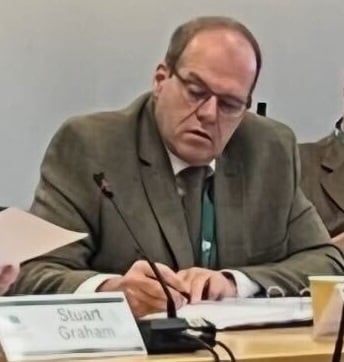
Serious questions have been raised over the process followed in dealing with a councillor’s “bullying” probe after the bill to the taxpayers topped more than £62,000.
Forest of Dean District councillors have reviewed the code of conduct process after the conclusion of a lengthy and complex complaint against Councillor Philip Burford.
The Independent councillor for Hartpury and Redmarley was censured and banned from committees for three years in December after his behaviour towards staff was deemed as “bullying” and having caused “dread”.
But questions were raised over the process in dealing with the complaint which took more than two years to resolve and recommendations have been made to try and avoid such a costly outcome in future.




The initial complaint was lodged in March 2023 and reached its conclusion in December last year and cost a total of £62,565,
A private investigation conducted by Barbara Beardwell was commissioned which cost £43,868.25 and £14,075 was spent on advice from a barrister.
Separate legal advice during the investigation cost £2,857.50 while training costs for the standards panel members totalled £1,464.85. The panel’s costs were £300.
Chief executive Nigel Brinn, who was appointed as deputy monitoring officer to deal with the case part way through the investigation, presented the review at the audit and governance committee meeting on March 25.
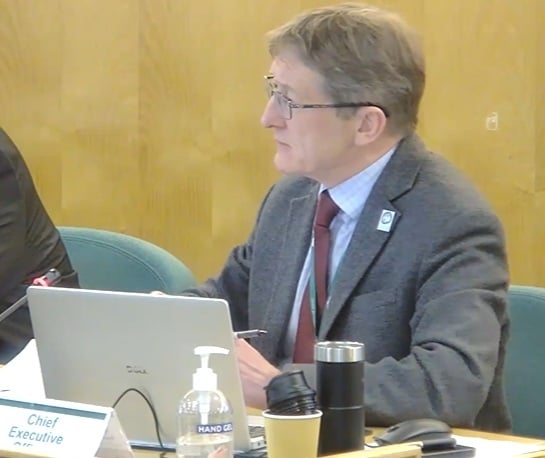
He said an investigator was appointed because the then monitoring officer had a conflict of interest.
Mr Brinn told the meeting that before they seek third party involvement in the future they should consider using their internal resources such as the counter fraud unit.
“If indeed we do embark on third party support, there may be good reasons going forward why we do that,” he said.
“I think then we need to ensure we have adequate project management around the costs involved.”
Councillor Julia Gooch (Progressive Independents, Newent and Taynton) asked how and who made the decision to appoint the third party investigator.
Mr Brinn said the decision was taken by the then monitoring officer after consulting with the council’s independent person.
“So the former monitoring officer employed the external investigator… Was there a consultation with anyone regarding that?”
Chief finance officer Andrew Knott said she spoke to him about the fact there would be external costs at the time.
Cllr Gooch asked if a limit to the costs was set of if it was “open ended”.
Mr Knott replied saying “this is where it gets very difficult”.
“Because, ultimately, as a section 151 officer I have to ensure that the monitoring officer has the resources in order to do a fair process,” he said.
“At the time, her view was that the fair process was to have an external investigator and that’s why they were appointed at that time.”
Chairman Harry Ives (C, Lydney North) said there was an issue in the process around individuals acting who had a conflict of interest.
“If the monitoring officer is recused due to a conflict of interest, then they must ensure they have no further involvement with the case whatsoever,” he said.
“That reads as common sense to me, but when you read the code of conduct timeline that has been produced by democratic services, the issue that this throws up from a process point of view is the first entry on this timeline, March 9, 2023 reads ‘initial complaint received’.
“On that day the monitoring officer would have become aware she had an interest in the complaint.
“So from that point on, there should have been no further involvement of the then monitoring officer in handling the complaint.
“And yet, when you look at the timeline the then monitoring officer, the conflicted monitoring officer, I’ll describe her as, goes on to appear in this timeline five further times.
“And on one occasion actually receives a copy of the draft investigator’s report prior to all of the other parties and is invited to make a comment. Which she then did two weeks later, returning that investigator’s report with corrections.
“So you have an interested party returning a copy of the draft investigator’s report with corrections. It’s inappropriate behaviour.”
Cllr Ives said the “conflicted” monitoring officer was also making decisions on the handling of a complaint that she herself had an interest in.
He went on to say: “The then monitoring officer was the individual who made the decision to refer this complaint to an external investigator rather than channel it through the counter fraud unit which I suspect is a major reason why the total costs of this complaint have reached £62,565.
“I suspect the sum total would have been less if it had been funnelled through the counter fraud unit.”
Mr Brinn said the monitoring officer should have stepped back from all of that activity at the time “just to give complete fairness and transparency to the process”.
But he added: “Before we go in the wrong direction, we reviewed all of this with the barrister’s support to make sure everything was above board and in hand before we brought it to the standards panel.
“We did do that legal check beforehand, so I think it’s more the perception of potential conflict of interest of further involvement, having identified a conflict of interest rather than any activity which was inappropriate.
“I just want to try and be as clear as I can on that front.”
Councillor Trevor Roach (G, Drybrook and Micheldean) said he was concerned about the really long timescale of the process.
“One question would be, have we got any mechanism by which we can make that timescale never so long again?”
He said it started when officers were “getting bullied in 2015”. “That situation grew until the start of the action in 2023,” he said.
“We are looking at an eight year period where the relationship between officers and a councillor was strained and probably exacerbated along the pathway.
“Officers need training to say, don’t tolerate it for eight years. There’s a question there as to why did it take eight years to go from when bullying started to when action commenced.”
He said the documentation suggests Cllr Burford quoted the council’s constitution which says a complaint must be submitted within three months of it happening to be considered unless there are exceptional circumstances such as bullying or harassment.
“We are looking at an eight year period here before any investigation started, so something was going wrong in that period,” he said.
Cllr Roach also referred to the report which suggested Cllr Burford said throughout the process that “it happened so long ago he could not remember”.
And he referred to council’s constitution which says complaints would not normally be referred for investigation if the matter occurred so long ago that it would be difficult for one to be carried out.
“The defendant often used ‘it happened so long ago, I can’t remember’,” he added.
Cllr Roach went on to ask what has been learnt to make sure it does not take so long again in the future.
“My main concern, especially given it was a bullying situation, the stress and strain that must have had.
“Then the long time it took to get the investigation started and then it took two years to get a completion.
“What have we learnt to make sure it doesn’t take eight years plus two years in the future.”
Mr Brinn said most complaints are between members and are dealt with quickly and confidentially.
He said harassment and bullying cases tend to take a longer time to get to a complaint because they are gradual.
“You’d probably always say at the end of a process, if you knew then what you knew now, you would probably do things slightly differently.
“That’s part of the challenge with dealing with complaints; they do tend to evolve and grow.
“But clearly, the sooner we can bring them to a close the better, more cost effective, better resolution, it just makes more sense you are not relying on long term memory.”
He said that specific case was complex and involved multiple complainants.
The committee noted the complex nature of the case, that due process was followed and the potential for considerable financial cost of processing complaints involving members.
Councillors agreed to recommend that if the monitoring officer is recused due to a conflict of interest, the chief executive officer must then ensure they have no further involvement with the case whatsoever.
They also recommended biannual training or councillors and officers as well as making sure all available internal options are exhausted before seeking external support.
If external support is required, they recommend that there should be appropriate project management put in place to ensure appropriate cost control.
Cllr Burford has declined to comment.
Comments
This article has no comments yet. Be the first to leave a comment.