

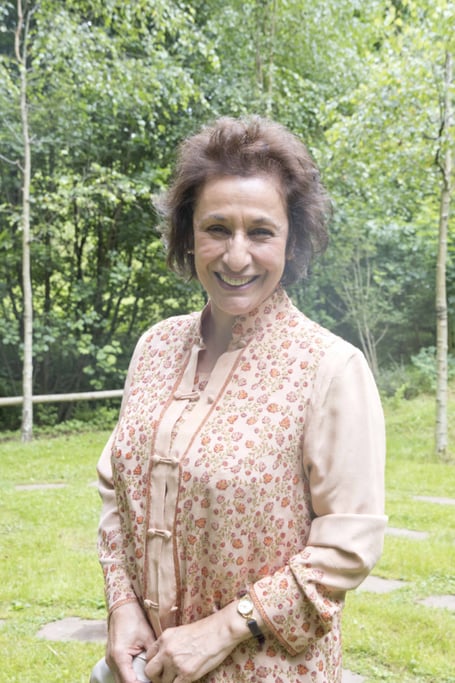
THE founder of an education centre in the Forest which supports young adults from around the world has paid tribute to one of the centre’s "most loved" patrons Archbishop Desmond Tutu, who passed away on Boxing Day.
Zerbanoo Gifford, who founded the ASHA Centre at Gunn Mill House in Flaxley in 1996, said the news of the Archbishop’s death at the age of 90 was received with "great sorrow" by everyone at the centre.
The humanitarian and author, who made history in 1982 when she became the first Asian woman in British politics to be elected as a Liberal councillor, has spoken about how the Archbishop inspired her as an active figure in the Anti-Apartheid movement, and of his support when she told him of her "dream" of building the ASHA centre years before it came into being.
Nobel Peace prize laureate Archbishop Tutu was one of the driving forces behind ending apartheid in South Africa, and was one of the country’s best known figures around the world.


He passed away in Cape Town on December 26 after a long-fought battle with cancer.
He received the Nobel Peace prize in 1984 for his work fighting apartheid, but Zerbanoo says the "iconic" figure also dedicated his life to "the relentless fight against all forms of injustice."
"He will be remembered for his peace and reconciliation committee initiated by Mandela in South Africa, which Tutu chaired with such compassion," she said.
"But he will also be remembered for the way he challenged Mugabe, another African, for the untold horrors in Zimbabwe, and those involved in the bloodshed in Northern Ireland and Israel and the cruelty against the Muslims in Myanmar.
"Tutu said it as it was, he was brave and a man of integrity."
Zerbanoo described the Archbishop as "a wise friend" and "one of ASHA centre’s most loved and admired patrons".
The pair first met at Saint Martin in-the-Fields church in Trafalgar Square in London, at which many found comfort before standing outside South Africa House where at least one person stood in vigil until the day Nelson Mandela was released, and the world saw "the end of the barbaric apartheid days."
Zerbanoo was an active member of the Anti-Apartheid movement, and says she was inspired by Desmond Tutu, Govan Mbeki and "indomitable feminist" Frene Ginwalla, who ran the ANC office in London.
She recalls being given the honour to speak at Trafalgar Square to hundreds of thousands of Anti-Apartheid protesters, and then being chosen along with the late Bishop Trevor Huddlestone - a close friend of Archbishop Tutu - to present a petition from the British people to Prime Minister Margaret Thatcher at No 10 Downing St, which called for full mandatory sanctions against the apartheid regime in South Africa and the release of Mandela.
Zerbanoo describes the presentation as "one of the pivotal moments" of her life as she knew that apartheid would come to an end, "as all evil eventually does when there is a ground swell to stop such indignities against innocent people."
The next time they met, Zerbanoo said a prayer with Archbishop Tutu to celebrate the work of the South African Memorial trust, a charity working for education for black South Africans deprived of education during the apartheid years, of which they were both patrons.
Zerbanoo says the mood at that event was very different, with Tutu’s "distinctive giggle and sheer magnetic personality" making it a memorable occasion.
She said: "He danced around the church which was filled with the good and the great. His sheer vitality and joy of living was infectious."
She recalls trying to keep up with him as he danced around the church, and telling him of her dream of starting the ASHA centre, although she had no idea where it would be or when it would happen.
Tutu told her "to have faith as God made miracles happen."
Some years ago, although ill with cancer, Tutu graciously wrote some "beautiful" words about Zerbanoo at the back of her biography, written by New Zealand editor Farida Master, called ’An Uncensored Life.’
He stated that Zerbanoo’s "commitment to peace, to young people and to creating a better world is evident from her track record."
He wrote: "As the first Asian woman in modern British politics elected as a Liberal councillor, her vision led to alternative ways to make a real difference - and she trod that path regardless of the challenges.
"Today we can see that journey has borne fruit and give thanks for all she stands for."
Zerbanoo says that besides being "a great soul who loved people", Tutu was known for calling South Africans the rainbow people.
He sent his book ’The Rainbow People of God’ to Zerbanoo and wrote inside a short thank you for her solidarity and campaigning against apartheid during "those terrible years".
Zerbanoo, who is known for her work across communities and faiths, says she loves the idea of a rainbow people, and admits to always having a fascination with rainbows since she was a young girl, when her father convinced her that there was "something wonderful at the end of the rainbow, maybe a pot of gold!"
She recalls that when the ASHA centre was finally opened, her Zoroastrian community came to bless the centre and had a "wonderful" Parsee meal.
Zerbanoo told the invited guests that if her father Bailey Irani - who many knew as the "big-hearted" founder President of the World Zoroastrian Organisation - was happy, they would see a rainbow.
No rainbow appeared, but as the group left in their bus back to London, one of the guests - South West England MEP Glyn Ford - rang from his car and told her to "look up" - there were two rainbows over the ASHA centre, one for her father and the other for Archbishop Tutu.
Zerbanoo’s ASHA Foundation provides "transformational educational experiences" for young adults to help them gain real world, practical skills, as well as the confidence and focus to apply them successfully in life.
The centre is described as a place where people of different nationalities and religions can "live and work side by side", with a focus on sustainable living and the arts.
Comments
This article has no comments yet. Be the first to leave a comment.