
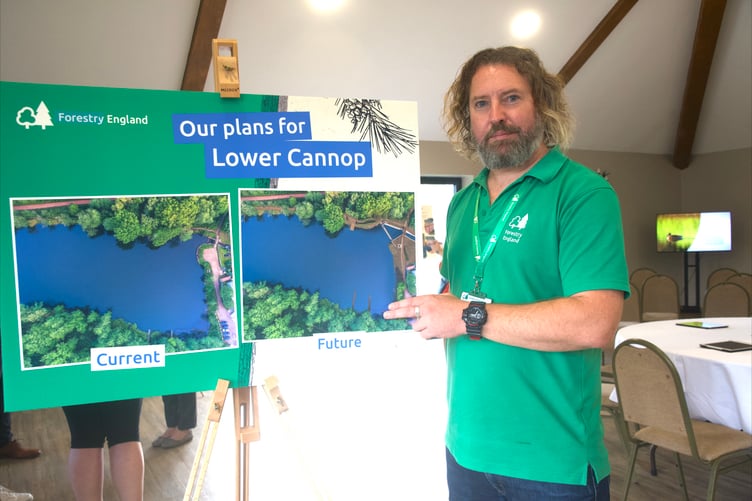
MAJOR engineering works needed to bring Cannop Ponds up to modern standard go well beyond simple repairs, says the man leading the project for Forestry England.
Some of its proposals, including replacing existing features with newly-built structures, have been controversial.
The volume of water in the upper pond would be reduced from 28,000 cubed metres to 10,000 cubed removing it from the scope of the Act.
It is also proposed to create an all-access trail and boardwalk below the dam, a wider bridge across the spillway, more seating next to the water and re-routing the Colliers Trail cycle path.
On the lower pond it is proposed to replace the spillway and install a “draw down” mechanism.
Path surfaces would be upgraded, accessible fishing platforms renewed and installing an accessible bridge over the new spillway.
The £25 million scheme is chiefly concerned with ensuring compliance with the Reservoirs Act, said senior project manager David Fish..
Inspections under the 1975 Act had previously allowed some latitude for historic structures such as the 200-year-old Ponds.
But expectations tightened following an incident in which a spillway at the Toddbrook Reservoir in the Peak District failed in 2019, leading to the evacuation of 1,500 homes.
Mr Fish said: “The project's all about the Reservoirs Act, and that's a fairly complicated document.

.jpeg?width=209&height=140&crop=209:145,smart&quality=75)
“The onus is on a reservoir owner to register their reservoir under the Act.
So we need to register it with the Environment Agency.
“That was always the case with the lower pond.
“But it wasn't the case with the upper pond
“It was felt, that it held less than 25,000 metres cubed of water, which is the current threshold.
“What essentially happened is we had a maintenance issue on the lower pond.
As part of that, we're supposed to have an inspection every 10 years.
As a result that inspection was called early, and the inspecting engineer took a look at upper pond and one of the measures he gave us to address was to assess whether or not it should be in the Act or not.
“That was back in 2021 – it was assessed as being over the threshold, it needed to be registered, and we've got a project on the upper pond.
“With the lower pond, the compliance issues in terms of the spillway size are quite interesting.
“With inspecting engineers, I think it's probably fair to say, over time, there's been a certain amount of leniency when it comes to historic assets.
“But, this is only a kind of guess, I think after the 2019 Toddbrook incident, which was a big reservoir failure, I think they're just a bit more stringent.
“So not only have we got a maintenance issue, there’s then a question about the age of the spillway.
“The spillways need to be replaced and they need to be replaced by spillways that are to modern compliance standards which means they have to be much bigger.
It's much more about rebuilding what's there to a modern standard than it is about just doing some patch up repairs.
“The other thing that we don't have, aside from the size of the spillways is we're supposed to have a separate system for drawing the reservoir down.
“So if we need to do maintenance, we're able to draw the level down or empty it to a state or find a different way of the water getting out of the reservoir so that we can do repairs.
“That doesn't exist. So that's another compliance issue.
“At any point, at the last inspection in, I think, 2013, it could easily have come up as a measure: replace a spillway, it’s not big enough.
“Certainly after Toddbrook, everything has sharpened minds, and when you've got a maintenance issue, that's also going sharpen minds in terms of: this is actually 200 years old, and probably you need to take a proper look at it.
“It's only got a defined lifespan at the end of the day.”
Forestry England have held a series of consultation events at which the public could question experts about various elements of the scheme.
There is also an online consultation which runs until the end of the month allowing people to submit their views.
Mr Fish said: “The consultations are doing two things, really.
“They're informing people as much as possible, about the Reservoirs Act, the reasons for the scheme, the way we've approached the scheme.
“They're also to for people to give us feedback.
“And from that feedback, there will be things we can change and address and there will be things that we can't change.
“We have to put in the spillway, for example, but if people want more picnic benches, we can consider whether it's appropriate.
“So there are aspects of the scheme that definitely people influence.
“On the top pond, we’re seeking to remove it from the Reservoirs Act, which means reducing the volume from 28,000 metres to below 10,000 metres cubed because that's the threshold of the Act will start.
“We want that to continue to be a nice place to visit rather than having to have a large compliance spillway with deep sides.
“There will be more, what we call it, marginal habitat, so the water level will fluctuate a lot more than it does at the moment.
“That would mean that there's hopefully a different assemblage of plants within that area.
“The reality is that we're not looking for another visitor centre.
“We've got Beechenhurst, we've got Mallard's Pike.
“We don't want Cannop Ponds to compete with those.
“What we're after is doing the regulatory measures, upgrading the spillways, putting in the drawdown.
And then doing some things where, for example, we can enhance the ecology.
“But it would be, it would be remiss of us to try and pretend that there aren't parts of the project that can't change, it’s a tricky balance.
“I've got people telling me: ‘Don't do anything you don't have to’.
“I've also got people saying, Can I have a toilet block?
“I was asked the if we could put in a community slipway for for a boat on Lower Pond. We've said no.
“There are competing needs within the Forest.
“It's not the case that everybody has a single point of view, and that's reflective across the whole across the whole Forest.”
Further groundworks investigations will take place over the autumn with a planning application expected to be submitted to the Forest Council early next year.
If, as hoped, planning permission is granted in autumn 2027, the two-year construction phase would start in early 2028.
Forestry England has set up an online “virtual room” for the public to use as part of the consultation on the Cannop Ponds project.
The virtual room is available until Monday 2 November, providing an opportunity for people who were unable to attend an in-person engagement event to learn more about the proposed scheme.
Visitors to the virtual room will have access to the same information displayed at the in-person sessions and will be able to complete the same feedback survey.
Visit the virtual event space here: forestryengland.uk/cannop-ponds/virtual-room
For further information on the future of Cannop Ponds, visit: forestryengland.uk/cannop-ponds-future
Comments
We've recently changed our login process. If you have an account for commenting, you will need to re-register on the login window.
This article has no comments yet. Be the first to leave a comment.