

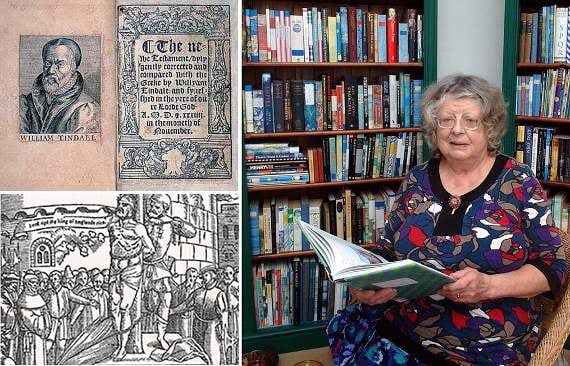
HISTORIAN Joyce Moss is about to set the historical cat among the ecclesiastical pigeons with a book claiming that 16th century religious reformer William Tyndale was a Lydney boy.
Conventional history records that Tyndale, the first person to translate the bible in to English, hailed from the Dursley area across the Severn.
During the 16th century he was a prophet without honour in his own time and his reward for his life’s work was to be strangled and then burned at the stake in Belgium.
His dying words were: “Lord open the King of England’s eyes.”


But within four years, his dying prayer was answered with publication of Henry VIII’s ‘Great Bible’ by Miles Coverdale, largely based on Tyndale’s work.
Joyce Moss is now putting the finishing touches to a book ‘Tradition, Reformation and Reaction in the Forest of Dean, 1450 – 1603’, in which using the arguments and research carried out by London historian, Andrew Brown she claims to have unearthed new evidence supporting Tyndale’s Lydney lineage.
She said: “It is becoming increasingly evident from recent historical research the Tyndale, the first man to translate most of the Bible into English from the original Greek and Hebrew and one of the greatest scholars of the sixteenth century, came from Lydney.
“It has often been presumed that Tyndale came from Gloucestershire, south of the Severn estuary. “But new research has revealed that Tyndale was ordained in Hereford Cathedral and the only part of Gloucestershire in the Hereford Diocese before 1540 was the Forest Deanery.”
Comments
This article has no comments yet. Be the first to leave a comment.