
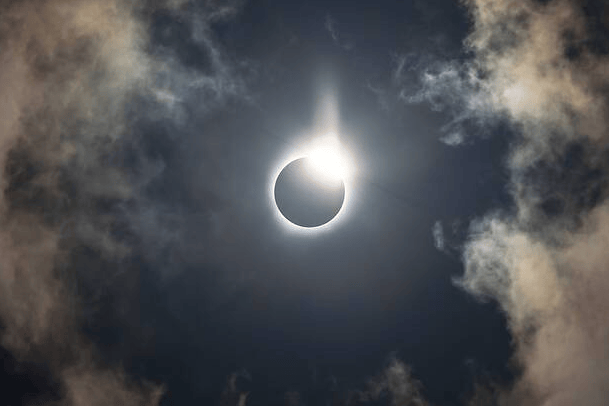
SKYWATCHERS across the Forest of Dean are in for a spectacular evening tonight as more than 92 per cent of the Sun is expected to disappear behind the Moon.
The partial solar eclipse will be the most impressive seen from the UK and Ireland in 27 years.
Across the Forest of Dean, the eclipse is expected to begin at around 6.16pm, with peak viewing between approximately 7.10pm and 7.15pm. In parts of the district, as much as 92.6 per cent of the Sun is expected to be covered, before the eclipse comes to an end at around 8.06pm.
A solar eclipse occurs when the Moon passes between the Earth and Sun, blocking some or all of the Sun's light from reaching parts of the Earth.
Tonight's event will be a total eclipse in parts of Greenland, Iceland and Spain, but from Britain the Moon will not quite completely cover the Sun.
Despite that, the Royal Observatory Greenwich says it will be the best solar eclipse visible from the UK and Ireland so far this century, with around 90 to 96 per cent of the Sun obscured depending on location.
Because the eclipse is taking place during the evening, the Sun will already be getting low in the sky. Anyone heading out to see it should therefore look for somewhere with an unobstructed view towards the western horizon.
That makes some of the Forest's higher and more open viewpoints potentially ideal.
May Hill is among the strongest candidates, offering panoramic views from one of the highest points in the area, while Ruardean Hill and Pan Tod Beacon also offer elevation and far-reaching views.
Symonds Yat Rock is one of the area's best-known viewpoints, although eclipse hunters will need to make sure they can find a clear view towards the west.

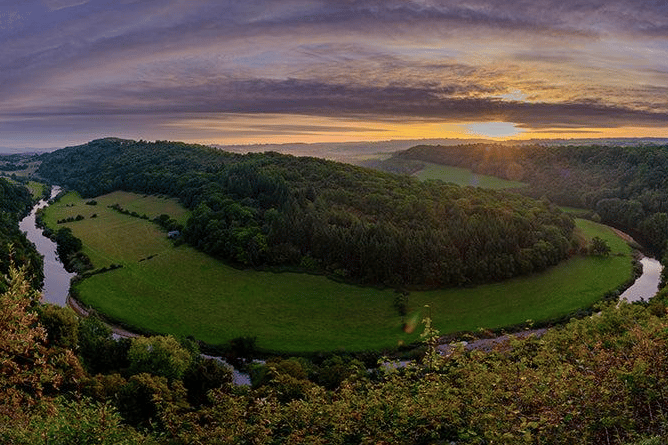
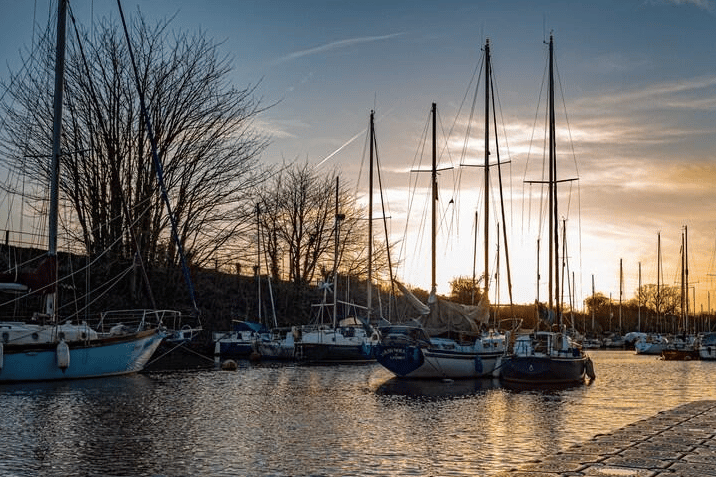
For those who would rather have a wide-open horizon than climb a hill, Lydney Harbour could also prove a good option, with expansive views from the banks of the Severn.
The Royal Observatory says the eclipse should cause a noticeable reduction in both light and temperature around its maximum. However, because this is a partial rather than total eclipse, the sky will not become completely dark and is instead expected to resemble dusk or a heavily overcast day.
Experts have also issued an important safety warning for anyone hoping to watch the eclipse, stressing that people should never look directly at the Sun without suitable eye protection, even when more than 90 per cent of it is obscured.
Astronomers warn that ordinary sunglasses do not provide sufficient protection for eclipse viewing. Instead, specially designed eclipse glasses meeting the ISO 12312-2 safety standard should be used, while the eclipse can also be viewed indirectly using methods such as a pinhole projector.
Experts also warn against looking at the Sun through telescopes, binoculars or cameras unless the equipment is fitted with an appropriate specialist solar filter.
Those unable to get outside can still follow the event online, with the Royal Observatory Greenwich broadcasting the eclipse live from 6.10pm.
The last total solar eclipse visible from the UK was in 1999, when Cornwall fell within the path of totality
The next comparable near total eclipse visible from Britain will not arrive until September 2081, when as much as 99 per cent of the Sun will be obscured in some areas. Anyone hoping to see another total solar eclipse from the UK will have to wait even longer, until 2090.
Tonight’s celestial show may not end when the Sun disappears below the horizon.
The Perseid meteor shower reaches its peak overnight, potentially producing numerous shooting stars across the night sky.
The Perseids are created when Earth passes through debris left behind by Comet Swift-Tuttle, with tiny pieces of material entering the atmosphere at enormous speeds and burning up to produce streaks of light.
The Royal Observatory says conditions are particularly favourable this year because the shower's peak coincides with a new Moon, meaning moonlight will not wash out the fainter meteors.
Under ideal conditions, astronomers say the Perseids could produce as many as 150 meteors an hour at their peak, although the number actually visible will depend heavily on cloud, light pollution and viewing conditions.
With its countryside, elevated viewpoints and comparatively low levels of artificial light, the Forest of Dean and Wye Valley is already promoted as a destination for stargazing, making it a potentially excellent place to continue looking upwards long after the eclipse has finished.
Comments
This article has no comments yet. Be the first to leave a comment.