

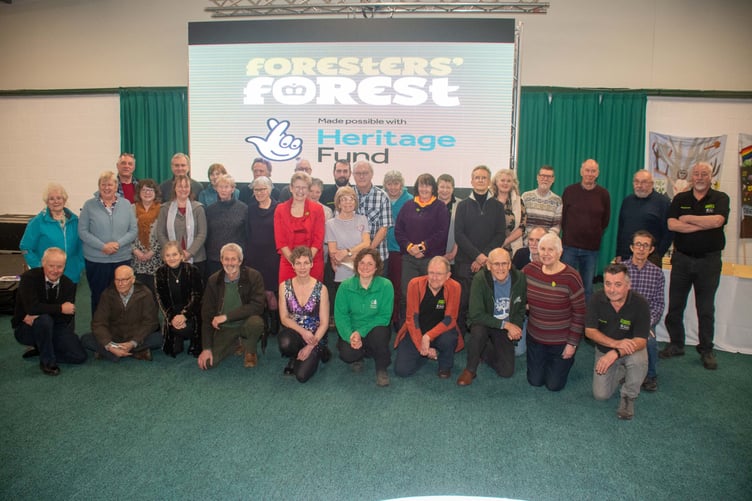
VOLUNTEERS and project staff came together last week to celebrate what has been achieved in five years of the Foresters’ Forest Landscape Partnership Programme as the project’s funded period draws to a close.
Hundreds attended an all-day celebration of the Lottery-funded heritage project last Wednesday (March 16), in which volunteers and project staff were recognised for their achievements and dedication to improving our understanding of history, culture and nature in the Forest of Dean.
The £2.5 million project officially ends on March 31, but leaves behind a legacy of projects that will continue.
More than 1,000 volunteers have contributed over 37,000 hours to the scheme since it began in 2017, and it is estimated that if they had all been paid for their efforts, it would have cost a massive £831,000.
.jpeg?width=209&height=140&crop=209:145,smart&quality=75)



At the celebration at Forest Oaks Farm in Lydney, volunteers who had contributed between 50 and 500 hours of their time were honoured with awards, and special recognition was given to a trio who had racked up more than 1,000 each.
They were Jane Mariot, who gave much of her 1,132 hours to support Heritage Open Days, David Dewsbury who spent 1,134 hours on reptile, wetscape and butterfly projects, and Alison Collison, who has given 2,677 hours to the restoration of Scarr Bandstand.
Alison said the achievement would not have been possible without the support of other volunteers.
Coleford Mayor and Forest Voluntary Action Forum’s Nick Penny, who logged all those hours, acted as MC for the awards, while guests at the event were entertained by local singer-songwriter and poet Dick Brice.
Nick told assembled guests during the ceremony: “Over the last five years 37,200 hours have been logged which is amazing and the monetary value of that is over £830,000 worth of voluntary activity.”
Since its’ launch five years ago, the 32 partners and 38 projects have made a huge impact on protecting and sustaining much of the Forest’s most at-risk nature, wildlife, and built and buried heritage, whilst actively celebrating the area’s rich culture and history.
The majority of the projects - 26 in total - will continue their work, using the skills and expertise that local people have developed over the years.
The programme’s website, www.forestersforest.uk, will also remain active with information about the work of each of the projects.
The projects are grouped under five themes - ‘Our Stronghold for Nature’, ‘Exploring Our Forest’, ‘Revealing Our Past’, ‘Celebrating Our Culture’ and ‘Securing Our Future’.
The ‘Stronghold for Nature’ projects saw a consensus develop among organisers on biodiversity management, which will support future work in the Forest.
Their achievements have included improving habitats for bats, birds and reptiles, and training volunteers to recognise and survey rare plants and care for and maintain important habitat.
The Conservation Grazing project has seen wildlife teams and partner organisations develop some 80 hectares of open habitat at Woorgreens, Edgehills and Wigpool through livestock grazing, and knowledge of the benefits for biodiversity has increased as a result.
Access has been improved across a number of key sites in the area through the ‘Exploring our Forest’ projects, including guided walks, the development of sites to encourage the community to engage with nature, apps that allow users to explore local heritage, and two off-road ‘trampers’ which have made the Forest accessible to more than 1,000 people.
Projects to ‘reveal the past’ and develop the understanding of local geology have included mapping archeological sites and community digs, craft skills workshops, a ‘Geo Heritage’ app and explorations of Forest dialect and oral histories.
The restoration of Scarr Bandstand in Sling, the ‘Love Your Forest’ campaign to discourage littering and increase recycling, and the identification of 48 local authors and the sharing of their works through a podcast series are just some of the projects which ‘Celebrate Our Culture’.
The programme to ‘Secure Our Future’ has seen engagement with some 1,655 local children through outdoor activities and learning sessions, and ‘Youth Rangers’ have worked with more than 30 teenagers to develop their understanding of local heritage.
Foresters’ Forest programme manager Sue Middleton said: “The Foresters’ Forest programme has clearly demonstrated effective collaborative working and community engagement.
“For everyone involved, the increase in knowledge and awareness of heritage, added information generated, the social capital and skills that have been developed, along with the management and leadership experience gained, have laid a foundation for more effective involvement of the local community in the future conservation and management of their heritage; helping make the area more resilient and adaptable to future change.”
Comments
This article has no comments yet. Be the first to leave a comment.