

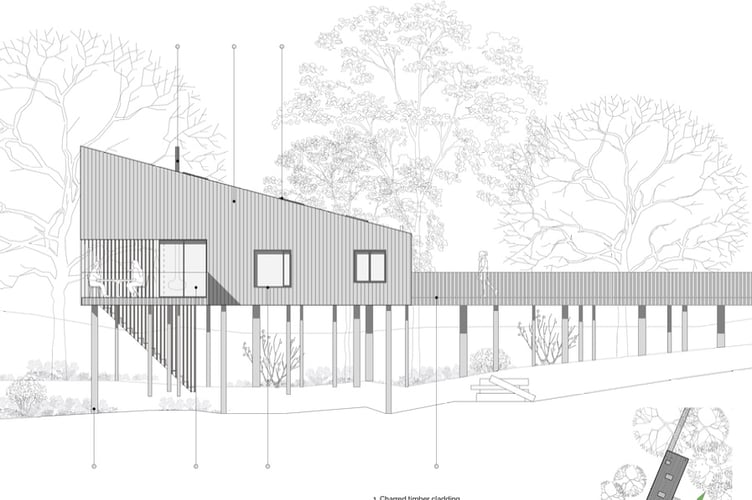
THE architect who worked on the project to build a black-clad treehouse in the Forest countryside says he wants to “raise awareness of well-considered design in the rural environment.”
Scott Hills of Brockweir-based Hills & Co told The Architect’s Journal that the planning process to get permission for the structure near Woolaston was “arbitrary and arduous”
The 47sq m house on stilts in the grounds of applicant Tom Kelly’s home has permission to be used only as a holiday let.
The “luxurious retreat in the woods” at Green Acres, Parkhill, features a bedroom, a bathroom and an open plan living/dining/kitchen area.”

It will also have a balcony plus access via a ramped walk way from the meadow through the trees.
Mr Hills noted that the obstacles in the14-month planning process had been “mostly legislative and rarely design-related”.
He told The Architect’s Journal: “The biggest challenge [involved] countless ecological surveys for bats, dormice, birds and great crested newts and the need for “goalpost shifting” additional information requested by the local authority at each step.”
“Thankfully our clients had a lot of staying power throughout and were determined to persevere, even though at times approval seemed doubtful.”
A report by a planning officer from the Forest Council report granting permission acknowledged: “This application has been delayed due to the need for additional ecological surveys and information to be provided…
“This is a unique building and the design and scale of the proposal are considered to be appropriate for the proposed use and location within the open countryside…
“To ensure that it is not used as a residential dwelling during this period, a condition will specify that the holiday let cannot be occupied for a period exceeding four weeks for any single letting, and that there shall be no return within four weeks by the same household.”
The report also noted that it is “a sensitive ecological site with the potential to impact on a number of protected species including lesser horse shoe bats, dormice and great crested newts”, but conditions such as “automated black-out blinds” and other measures were appropriate to protect the wildlife.
The house is expected to be completed by next spring and will have a glued, laminated – or glulam – structure and time joists and be clad with charred cedar.
Mr Hills told The Architect’s Journal they wanted to “raise awareness of well-considered design in the rural environment”.
But he said that with some local authorities “offering residential design guides that are two decades out of date and no real planning legislation for sustainability and low-energy developments, there remains a long way to go”.
He said that as well as “countless” bat surveys, they had done a “full lighting assessment and detailed mitigation strategy”.
“To receive planning approval to develop this low-energy, elevated black-clad, new-build, contemporary treehouse in an existing woodland bordering an AONB, (through a pandemic) was no small feat,” he added.
Comments
This article has no comments yet. Be the first to leave a comment.