
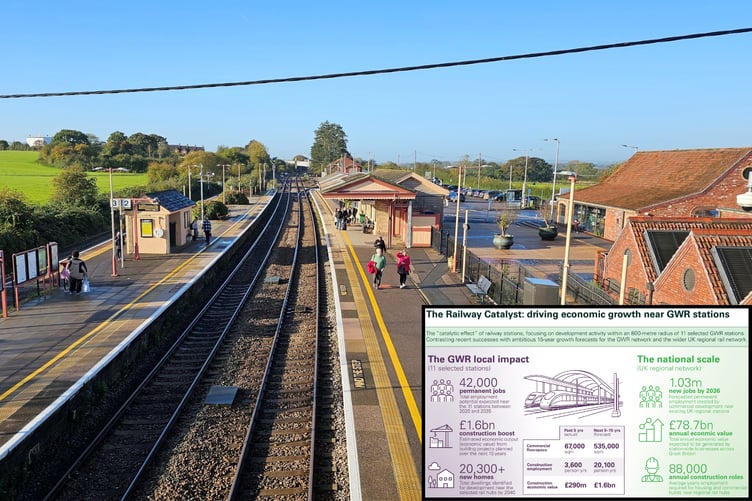
A MAJOR new report from Great Western Railway has strengthened the case for rail investment across the Forest of Dean, as local leaders continue to explore the potential return of a line linking Gloucester, Ross-on-Wye and Hereford.
The study highlights what it calls the “Rail Catalyst Effect”, the idea that railway stations act as powerful drivers of economic growth, unlocking jobs, housing and investment in surrounding communities.
According to the research, rail development across the UK could support more than one million jobs and generate £79 billion for the economy by 2036. Within the GWR network alone, stations are projected to create 238,000 jobs and £14.25 billion in annual economic value over the next decade.
While much of that growth is focused around larger stations, the report also points to significant benefits at a regional level. This could be particularly relevant to areas like the Forest of Dean and Ross-on-Wye, where rail connectivity has long been limited.

The findings come just weeks after councillors backed calls to explore a new rail link between Gloucester and Hereford, potentially passing through the Forest and Ross. The proposal includes the possibility of new stations to serve planned housing developments, including the garden town proposed near Churcham.
GWR’s report suggests that developments within walking distance of stations, typically within 800 metres, can deliver thousands of homes, jobs and new commercial space. Across just nine stations in the South West and South Wales, similar investment has already supported 4,500 jobs and generated £328 million annually.
For the Forest of Dean, where more than 13,000 new homes are planned over the next 20 years, the link between rail infrastructure and sustainable growth is becoming increasingly important.
Mark Hopwood, Managing Director of GWR, said: “The findings of this report are clear: the railway, its stations, and the trains that serve them are powerful drivers of economic growth, community prosperity and regeneration.”
He added that rail investment is already helping to deliver “thousands of homes, new commercial space and thousands of jobs” across the network.
Beyond the economic benefits, the report also highlights the social value of rail, particularly in areas where car ownership is lower. Around 22 per cent of households in England do not have access to a car, meaning rail links can play a vital role in connecting people to employment, education and services.
With large-scale housing growth planned on both sides of the Gloucestershire and Herefordshire border, local leaders have argued that infrastructure must keep pace.
The renewed focus on rail investment could therefore prove significant for communities across the Forest, as discussions continue over whether a new line, and potentially new stations, could help shape the area’s future growth.
While any scheme remains at an early stage, the GWR report underlines a key message already being echoed locally, that railways are not just about transport, but about unlocking opportunity, investment and long-term sustainability for communities.
The full report outlining the findings of the “Rail Catalyst Effect” can be downloaded from the Great Western Railway website
Comments
This article has no comments yet. Be the first to leave a comment.