
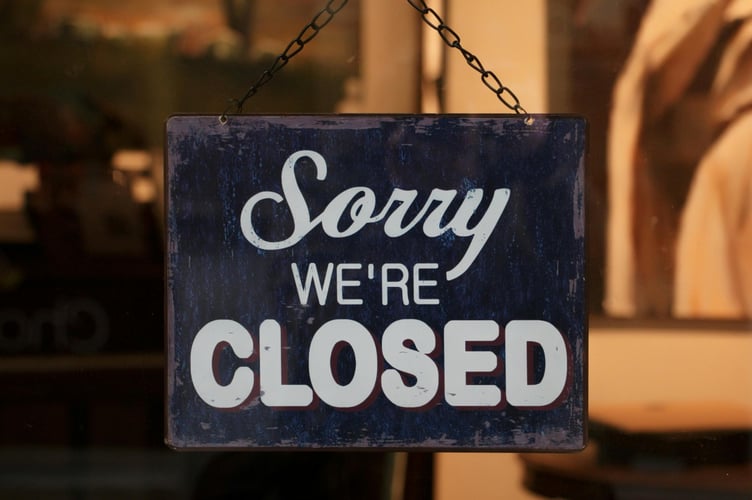
IT would perhaps be an understatement to say it is a tough time for business owners right now, and Forest of Dean businesses are no exception.
Amidst a cost of living crisis, many people are tightening their belts or looking to save a few quid for goods and services online - and of course, this makes sense financially.
However, local businesses ultimately lose out. A reduction in trade often means a reduction in profits, and over time this can be fatal.
Last week, I reported on a study which analysed recent government figures. The study suggested the Forest of Dean saw the steepest decline in business growth across the county between 2019 and 2025.




The analysis showed the number of VAT/PAYE businesses in 2025 revealed to be 8.27 per cent lower than in 2019. That year, the Forest of Dean had 4,110 businesses, which reduced to 3,770 in 2025.
Could the cost of living crisis be at the heart of this, or are there other reasons for the decline in businesses within the Forest of Dean?
This week, I sought to find out more.
The bigger picture
Businesses across the country are closing in significant numbers. According to figures from the House of Commons Library, an estimated 285,000 businesses closed their doors completely in 2025. A year before, an estimated 280,000 businesses closed.
The Office for National Statistics showed the figure in 2023 was 309,000, and 2022 was 349,000.
While these alarming figures show the number of ‘business deaths’, they do not show the full picture. Many businesses across the country have experienced growth, and many businesses were born in these years.
So, what about the Forest of Dean? According to Gloucestershire County Council’s data, the business birth rate in the Forest was 8.2 per cent in 2024, which was below the overall figures for Gloucestershire, the South West and England and Wales respectively.
But the Forest of Dean also saw the lowest business death rate of all these categories at 7.7 per cent
Gloucestershire County Council noted in the report: “The combination of low business births and low business deaths suggests relatively low business churn in the Forest of Dean, indicating a more stable but less dynamic business base.
“Deaths of enterprises are generally caused by an enterprise’s lack of economic success, or structural problems within the economy that make it impossible for the business to survive.”
Put simply, the county council is suggesting these figures are due to a low number of new businesses, but the ones that remain are stable and do not unnecessarily change their approach.
The council may have a point here. This year, I’ve reported on Newnham’s Casa Interiors celebrating its ten year anniversary, and Coleford’s Forest Sweets and Treats celebrating its third year of trading.
Paula Farmer, Owner of Casa Interiors, told me she has regular customers who come and the interaction they have is an important area of their social life and wellbeing.
Tanya Pritchard, Owner of Forest Sweets and Treats said: “We have been very lucky that we have sustained local support within our community and have also been able to diversify into supplying birthdays, weddings, baby showers with sweet packages, sweet cones, etc. We have also been able to expand into local fairs and local events taking place with our own stall.
“Yes it can be hard work and long hours, but we have a passion for what we are achieving and where we want to be.”
What both these businesses alluded to was strong community support.
Community support
So, if community support keeps these businesses alive - does that mean that business deaths are due to a lack of community support? Not necessarily.
What I think is more symptomatic is how the cost of living crisis is affecting the pockets of both the community and the business owner.
Tanya Pritchard said: “In this day and age with technology and online shopping it can be difficult for businesses to survive, especially with less and less footfall around the Forest towns and the cost of living. It's such a shame to see more and more shops closing their doors.
“We talk about regenerating our towns and I would love to see Coleford become alive again, with monthly markets around the Clock Town, brightly painted shop fronts and all the shops occupied and thriving and bringing in more locals and visitors.”
Shopping habits of the community
It is clear that nobody wants to see a business or community asset disappear from the local area. However, with the cost of living ever-rising, the shopping habits of the consumer changes.
A Forest of Dean resident, who wished to remain anonymous, told me about the way they shop and managed money over the last few years. For the purposes of this article, I will refer to them as Mr Smith.
Mr Smith said: “I found that over the last two years, maybe three, I’ve had to go online to buy things because the costs are just much cheaper.
“I never used to go online [for items] and I’m a big fan of looking in local shops for gifts or my usual shopping. The thing is, I just don’t have the luxury to spend money getting to town, not knowing if they have what I want, and spending extra on something I can get online and have it delivered.
“I feel sorry for local businesses and it’s tough for them now, but it’s tough for all of us.”
Mr Smith is not alone here. Data from the Office for National Statistics shows that online shopping remains high, and while there has been a slight drop since the coronavirus pandemic where we had little choice, it’s still higher than pre-pandemic levels.
The Office for National Statistics website says: “Shopping online became the norm during the coronavirus pandemic, but for some sectors, the sharp shift towards online purchases may be more lasting.
“Despite restrictions easing and people returning to the shops, there are some things we’re buying online more, notably in the categories of clothing, electrical household appliances, and sports equipment, games and toys.”
The 2025 data for internet sales as a percentage of total retail sales was 27.5 per cent, whereas pre-pandemic in 2019, that figure was 19.2 per cent.
It’s important to note this data could be related to the cost of living crisis, but it may also be symptomatic of consumers’ shopping habits having changed as a result of the pandemic.
What do Foresters think?
When my previous story about business decline was published, a few readers commented on the story via social media.
One person said: “The bridge tolls stopped in 2018 so businesses are not investing on this side of the bridge anymore.
“With the increase in work from home during Covid again, why base the business in a difficult to get to area.”
Another reader said the decline was down to increasing employment costs, utility rises and taxation.
What’s the real answer?
I don’t think there’s one answer to give. The cost of living crisis is a symptom of a number of factors, as is business decline. It wouldn’t be fair to say the crisis has directly led to the business slump, but it certainly has not helped.
What’s more important is we recognise the businesses still serving the community in the Forest of Dean, especially given such challenging times - and hopefully in time, the Forest can see a surge in business growth.
Comments
This article has no comments yet. Be the first to leave a comment.