

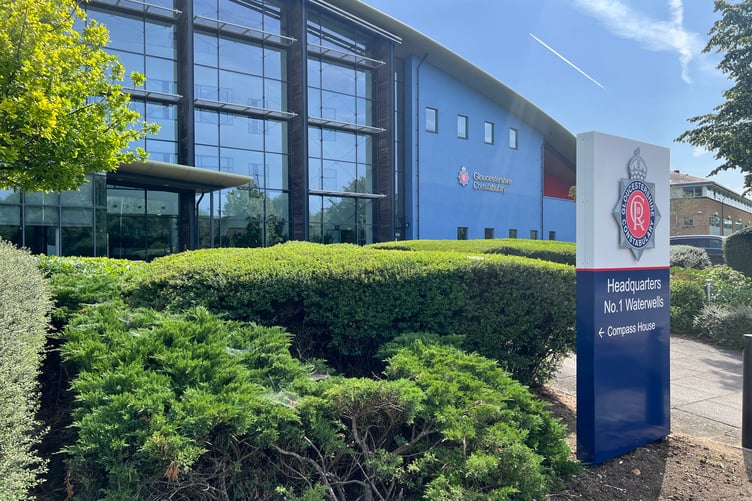
Not enough criminals are being brought to justice with understaffed Gloucestershire police teams dealing extremely high workloads, inspectors have found.
The performance of Gloucestershire Constabulary has declined in many areas since its last inspection, His Majesty’s Inspectorate of Constabulary and Fire and Rescue Services (HMICFRS) has said.
The investigation of crime has been found inadequate while managing fraud, safeguarding people, responding to the public, preventing crime and developing a diverse workforce all need improvement.
There have been improvements in several areas including response times to emergency and non-emergency calls, responses to the public and how police use stop and search powers.
The results of Gloucestershire Constabulary’s PEEL (Police Effectiveness, Efficiency and Legitimacy) inspection, published last week and covering 2025-2027, graded Gloucestershire Constabulary’s performance across eight areas of policing and found the force was adequate in one area, requires improvement in five and inadequate in two.
The force’s temporary Chief Constable, Maggie Blyth, said the findings “underline the urgent need for additional support from Government and for national police reform.”
Police and Crime Commissioner Chris Nelson – whose role is to ensure effective policing by setting priorities – said Gloucestershire is not adequately funded to prevent, investigate and solve crime.
His Majesty’s Inspector of Constabulary, Kathryn Stone, agreed progress has “to an extent, been hampered by insufficient funding and resources.”
“However, the people of Gloucestershire deserve a constabulary that can adequately respond to their needs.
“I have concerns about the performance of Gloucestershire Constabulary in keeping people safe, reducing crime and giving victims an effective service.”




Many areas of performance have deteriorated since the last inspection which covered 2023-2025.
HMICFRS found the constabulary hasn’t made enough progress in improving the standard of its investigations and as a result it still isn’t bringing enough offenders to justice.
The constabulary needs to improve how it protects vulnerable people, including how it manages its backlogs of safeguarding referrals and how it polices preventative orders issued to domestic violence perpetrators.
The constabulary also needs the capacity to investigate fraud and provide better outcomes for the public.
The inspection found officers in understaffed teams with extremely high workloads.
They were often unable to take leave or time off they wanted, and the majority of personnel said they wouldn’t recommend Gloucestershire Constabulary as a great place to work.
HMICFRS also found the Constabulary needs to improve how it manages its backlogs of safeguarding referrals and how it polices preventative orders issued to domestic violence perpetrators.
The constabulary also needs the capacity to investigate fraud and provide better outcomes for the public.
The force says the report highlights many areas where it does well.
Its response to 999 calls has “significantly improved” with 89.9 per cent answered within 10 seconds in the year ending in May compared with 59.2 per cent in the 12 months up to June last year.
It correctly prioritises the urgency of response and works well with partners to safeguard and reduce the risk of harm to vulnerable people
The force works with partners to prevent crime, divert young people away from crime and to reduce reoffending
It understands how it is using stop and search and use of force powers and is trying to do more to reduce disproportionality
It can show how it aligns finances to its priorities, how it evaluates value for money, and an understanding of future budgeting needs.
Temporary chief constable Maggie Blyth said she accepts the report, adding they reflect the findings she has been “very vocal on” since she took on the role two years ago.
She recognises the efforts of her officers and staff and believes they should not have such “unacceptable workloads”.
She said: “We accept the findings of our PEEL report as they are the same as our own self-assessment and reflect the long-term systemic challenges which I inherited.“Inspectors recognise we are driving forward changes, yet they acknowledge we are ‘restricted by financial constraints and poor IT infrastructure’.
“We have a fantastic workforce who go above and beyond to support victims and apprehend offenders and so it is both frustrating and disheartening to not be able to support them in the way we want to.
“I am proud of what my officers and staff do in very difficult circumstances.
“During the past couple of years, we have been relentless in our ambition and commitment to bring Gloucestershire Constabulary into the 21st century and improve our performance at pace, at a cost we can afford, and we have had some success.
“But this will take more time and investment.
“We are putting our finances right, modernising the police force with tech so our officers can do the job.
“And above all, we do answer the call when anyone rings 999. We are always there when there is an emergency.”
“We are due to implement a new operating model in the new year, which will include a growth in the number of detectives; while a recent independent audit has confirmed we have a grip on our finances.
“Unfortunately, these measures only take us so far and it is clear we are likely to still be unable to make all the changes HMICFRS expect.
“We have repeatedly asked for both practical and financial help and as a result, we have benefited in recent months from expert advice from the College of Policing while the Home Office has also provided a limited grant to help upgrade some of our computers.
“We are grateful for this support however, given some of the Constabulary’s technology dates back to the last century, significant investment is needed.
“As one of the smallest police forces in England and Wales though, we do not have the ability to invest in every area of our organisation, and we have to prioritise how we use our resources.
“Over the last three years, we have taken an average of £14.5m out of the organisation,” she said.
“That’s a massive amount to take out. It’s like eight per cent of the organisation we have had to take out to make ourselves financially viable.”
She said the force can now “balance the books” but “there’s a cost to that”.
“If you have to take that amount of money out, it has to come out from somewhere.”
She said other forces have been able to move quickly on IT upgrades and reiterated that the police will always be there for those who need it.
“Things are getting better,” she said. “We are now investing in the right things.
“Strong improvements have been underway all of this year.
“I am not the only Chief Constable to make the case for a more consolidated and coordinated approach to policing nationally, and I look forward to the establishment of a new National Police Service as well as the Home Secretary’s plan for what police reform will look like.
“We would welcome working with the Home Office in becoming a pathfinder force should one be needed.
“Our communities deserve a police force they can be proud of, but we know we cannot wait for reform, given it could take several years to implement.
“We are already engaged in discussions with the national Police Digital Service to help to turbocharge our ICT infrastructure and also with other forces about collaborations, and I’d like to reassure all those who live, work and visit our county we are doing everything we can.
“Our staff surveys repeatedly show our workforce is under significant strain, with many suffering from intolerably high workloads and being spread too thinly across different workstreams.
“Yet day after day they continue to serve the public, ensuring they are there for them when they need them most.
“I am proud of the improvements we have made in Gloucestershire in the past couple of years, particularly given the restraints we are working with, and of the continued commitment of our people to serve the public, but ultimately we can only do so much without more support or the modernising of policing’s structures through reform.
“The inspectorate will come back again in six months and will check on our improvements.”
She said they are on track for those improvements to be in place.
“I want people to feel that Gloucestershire feels like a better place to come to work in,” she said.
“People are feeling that the new kit is helping and people feel it is recognised that their workload is not sustainable. But I need to make sure it feels more manageable.”
She said that within six months the Constabulary should demonstrate it understands where officers and staff should be deployed, put processes in place to improve underperformance and implement an operating model that improves how effectively its officers and staff can deal with the operational demands.
Police and Crime Commissioner Chris Nelson said while the force is not performing at the required level, it was important to highlight substantial improvements.
He said: ““This report does not make pleasant reading.
“However, reassuringly, absolutely none of it is a surprise.
“Gloucestershire Constabulary has been struggling for some time, and an immense amount of work has been commissioned to address its performance shortcomings.
“But I fully recognise that this report is not good enough.
“To be rated inadequate in investigating crime, a fundamental service of a police force, is, to say the least, disappointing and reflects a weakness seen in many police forces nationally.
“A major issue is the lack of funding the force receives.
“It is simply not adequately funded to prevent, investigate and solve crime.
“My Office has made many approaches to Government to lobby for more financial support and continues to do so.
“The cost of policing Gloucestershire has risen far faster than the funding government makes available to us.
“This leaves forces like ours facing painful decisions about Council Tax, police visibility, investigative capability, and investment in key personnel and essential technology.
“We are being asked to meet increasingly complex crime with outdated systems and stretched resources, and that is not sustainable.
“Information Technology is a particular weakness for our force.
“We are currently dealing with the repercussions of historically poor decision making by Government.
“The outcome of this report is not good enough, but I truly believe we are on the right track.
“I see investment being made in the right places. I see historical deficiencies being addressed. I see senior leadership empowering change. I am hopeful for the future of Gloucestershire Constabulary.
“I will continue to hold the Constabulary and Chief Constable to account on behalf of the public – especially for those areas which are deemed inadequate.
“Faster improvement is non-negotiable and I will continue to demand higher performance, delivered at pace.”
“We’ve got solutions in place.
“This PEEL report is a moment in time from many months ago.
“Things are improving. My big push is for more pace and momentum in terms of the speed of the improvements and trying to find solutions where we can’t find enough money, being innovative with technology that will help us address the performance shortcomings.”
A Home Office spokesperson said: “This government is delivering the biggest reforms to policing in over 200 years to allow forces to better protect their communities and to focus on local crimes like burglary.
“Police force funding this year is at a historic high of £18.5 billion, with Gloucestershire Constabulary receiving a cash increase of 4.7 per cent.”
The spokesperson said that under the new Policing Performance System, Gloucestershire is allowed to receive continued support from the system to enable performance improvements.
In 2026-27 Gloucestershire Constabulary will receive up to £178.3 million of funding, an increase of up to £8.1 million compared with 2025-26, which equates to a 4.7 per cent cash increase and 2.7 per cent real terms increase.
In January, the Home Secretary introduced reforms t freeing up forces from arbitrary officer headcount targets, and putting more officers in high streets and town centres.
The Police Reform White Paper sets out a review to police formulavand distribution of funding, ensuring itis fair and responsive to local needs.

Comments
We've recently changed our login process. If you have an account for commenting, you will need to re-register on the login window.
This article has no comments yet. Be the first to leave a comment.