

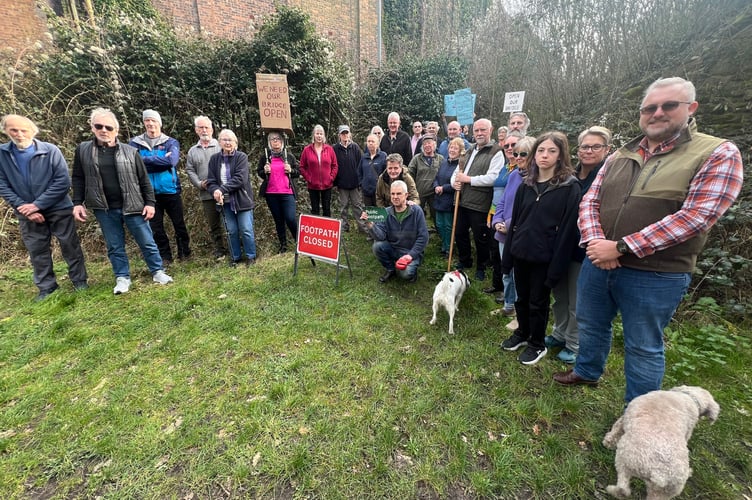
A BITTER row has erupted in the Wye Valley after council chiefs admitted that a beloved historic footbridge, crucial to the region’s tourism economy, has been sidelined indefinitely due to a staggering £3 million repair bill.
The Black Bridge near Lydbrook—a vital artery of the internationally renowned 136-mile Wye Valley Walk—faces a bleak, padlocked future. Local traders, walking enthusiasts, and disillusioned residents have expressed outright fury at what they call a "decade of municipal neglect" and broken promises by local authorities.
The former Victorian railway crossing, which spans the River Wye to link Gloucestershire with Herefordshire, has been plagued by closures for ten years. But any hope of a swift resolution evaporated this week. Highways bosses admitted they simply do not have the cash to fix it, revealing that the project has been pushed down the priority list behind other county hazards.
The escalating crisis came to a dramatic head at a stormy full meeting of Gloucestershire County Council. Confronting leadership in the chamber, Reform UK councillor Piers Camp (Drybrook and Lydbrook) demanded to know exactly when his constituents would get their walkway back.
Cllr Camp reminded the chamber that the council’s leader had publicly branded the reopening of the Black Bridge a "top priority" in August of last year, leading the community to firmly expect a reopening in the spring of this year.
"Spring has passed and the bridge remains closed," a frustrated Cllr Camp told the chamber. "Will the cabinet member now give residents a specific date by which the bridge will reopen to pedestrians?"
The response from the front bench was a devastating blow to the community. Mark Harris, the Liberal Democrat Cabinet Member for Highways, admitted he could not provide a date. Instead, he dropped a financial bombshell: the estimated cost to bring the crossing back into service has now rocketed past the £3 million mark.
"There isn't the money to do it at the moment," Cllr Harris stated bluntly, citing an ongoing, systemic funding crisis. He revealed that the local authority faces an asset maintenance shortfall of roughly £15.5 million every single year. "So there is this list of prioritising and so on, and that’s how unfortunately we square that one. It’s not high up the priority list as some of the other safety issues out there."
Also known as the Stowfield Viaduct, the imposing iron-and-timber structure originally carried the Ross and Monmouth Railway line, standing as a proud monument to the region’s industrial heritage. In its modern iteration as a footbridge, it welcomes tens of thousands of hikers annually, serving as a linchpin for local pubs, bed-and-breakfasts, and cafes that rely heavily on the influx of walking tourism.
However, the bridge’s history over the last decade reads like a manual in infrastructure decay. It was closed yet again following urgent structural inspections. Engineers discovered the wooden decking was in an "extremely poor condition," warning that if the public were allowed to keep using it, it would pose an immediate "danger to life."
Broken promises and a decaying icon
The escalating cost of the Black Bridge
2016: £500,000 ------ (Full 100-year refurbishment estimate)
2026: £43,000 ------- (Cost to strip decking and old scaffolding)
2026: £600,000 ------ (Quote for 5-year temporary scaffolding)
2026: £3,000,000+ --- (Current estimated cost to reopen)
At the time of the initial shutdown, Shire Hall issued reassuring statements, claiming teams were "working as swiftly as possible to repair the damaged decking and to reopen the bridge."
But as the months rolled by with zero visible progress, patience evaporated. In March, local villagers turned out in force for a mass protest at the site, demanding the local authority honour its word. The response they received came via a bureaucratic public notice the following month, officially extending the temporary closure by another six months. The justification? A fallen tree had caused fresh damage to the already crippled structure, and "works are still ongoing."
The true scale of the financial mismanagement, campaigners say, lies in the numbers. When the bridge first faced closures back in 2016, officials from the then Wye Valley Area of Outstanding Natural Beauty (AONB) looked into a comprehensive, top-to-bottom refurbishment. At that time, a fix designed to secure the bridge's lifespan for another 50 to 100 years was estimated to cost just £500,000.
A decade of inaction has seen that figure expand sixfold. Earlier this year, highways managers admitted that merely installing temporary scaffolding to prop the walkway up for a further five years would cost an "eye-watering" £600,000. Ultimately, the council chose to spend £43,000 just to rip down the old, unsafe scaffolding and rotten decking, leaving the bridge stripped to its bare iron bones.
Because the River Wye acts as a county boundary, the bridge is jointly owned with Herefordshire Council, with both authorities legally bound to split maintenance costs 50/50. Gloucestershire officials say they are now "in the process" of submitting an outline bid to the Department for Transport’s structure fund in a desperate attempt to source external cash, while investigating other grant opportunities.
They have also conceded that restoring the historic Victorian structure might be a redundant effort. Instead, engineers are considering abandoning the old walkway entirely to build a brand-new, modern pedestrian bridge—an option they claim might offer a more sustainable, long-term fit for the scenic landscape, though one that still requires millions they do not possess.
The council's justification for the delay has done little to calm local fury. During the council clash, Cllr Camp fiercely challenged the cabinet’s logic, pointing out that because the bridge is a legally recorded public right of way, the local authority has a strict, statutory duty to keep it open and accessible.
"How does it reconcile that duty with leaving it closed and crossing-free?" Cllr Camp asked. "And what weight does that duty carry in its funding bids?"
The council’s defence—that a £15.5m budget black hole forces them to choose between fixing a footbridge and sorting out critical road safety hazards elsewhere—has been met with deep skepticism by regional politicians.
Green Party councillor Sid Phelps, who represents Lydbrook at the Forest of Dean District Council and has championed the bridge’s reinstatement for years, expressed total disbelief at the new £3 million price tag.
"I would welcome a discussion with Cllr Harris and his officers to understand where the frankly eye-watering figure of £3m comes from," Cllr Phelps said.
"We need to understand how local councillors, residents, and hikers might work to re-instate this vital link in the Wye Valley footpath with a real, concrete plan—rather than just wishing on a wing and a prayer."
As the peak summer walking season gets underway, the gates to the Black Bridge remain firmly chained. For the thousands of hikers arriving to walk the Wye Valley path, the only reward is a lengthy, frustrating detour, while for the communities on either bank, the silence from the empty viaduct grows louder by the day.
Comments
We've recently changed our login process. If you have an account for commenting, you will need to re-register on the login window.
This article has no comments yet. Be the first to leave a comment.