
.png?width=752&height=500&crop=752:500)
I have this odd habit of asking all shopkeepers, casual acquaintances and business people whom I believe are from an Indian sub-continent heritage about their first language. At first I was a little apprehensive about asking this question.
This is probably quite impertinent, but I have an interest in the languages of India and its surrounding areas, and I have enjoyed many conversations (almost exclusively in English, but with a brief offering by myself in some easy conversational words), when I ask for their Indian heritage (or their heritage from the other nations of the geographical Indian sub-continent, which also includes Sri Lanka and Pakistan). I have always had courteous and informative responses, and I have learned some simple phrases to show my interest in some of these remote languages.


-x.jpeg?width=209&height=140&crop=209:145,smart&quality=75)

The main languages from this great linguistically diverse area are the national languages of Hindi (India) and Urdu (Pakistan). These are different national languages, but their differences are political rather than linguistic. They are mutually intelligible as spoken languages, and probably are as similar as British and American English. But Hindi is written in the old Devanagari script and Urdu uses a version of an Arabic/Persian script, written right to left.
Devanagari is written left to right, and the characters seen to hang down from a line above. There are some differences in nouns, with an Urdu ‘book’ a ‘kitaab’ and a Hindi book a ‘pushtak’. The phrase ‘al kitaab’ has spread throughout the Arabic linguistic area, crossing the Sahara to reach northern Nigeria, where ‘al kitab’ has morphed into ‘litafi’. There is another Hindi related language, Gujerati, spoken in the north west corner of India, and also just across the border from there into Pakistan. There are Gujerati speakers in Lydney.
In Sri Lanka and the southern tip of India the main language is Tamil, of which I have learned a tiny collection of phrases including ‘Poitu varen’ (goodbye), ‘Nandri’ (thank you) and ‘Vanakam’ (hello, greetings), which I try to remember every time I go to the general store in Lydbrook, where the heritage is Sri Lankan and not Indian. ‘Poitu varen’ and ‘nandri’ are often accompanied by a slight bow, an elegant gesture of respect.
Malayalam (not to be confused with Malayan) is another South Indian language, with speakers in shops at Newerne Street in Lydney and at the new Hospital at Cinderford, where you would get a nod of approval if you ventured into their linguistic world to speak simple phrases like ‘hello’ (namaskaram), ‘thank you’ (nandi, similar to the Tamil word) and ‘good bye’ (vida). I haven’t quite got the names for any of the groceries or medical services yet. Work in progress. Malayalam and Tamil are the main languages in the Dravidian family, which includes other languages in southern India and Sri Lanka.
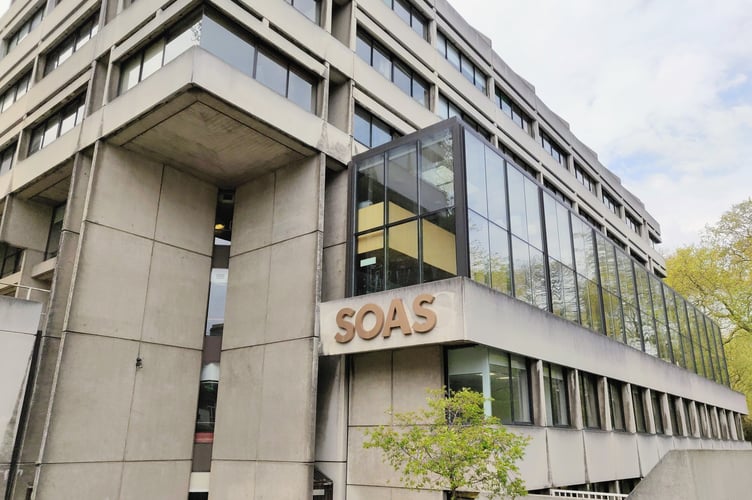
My interest in the languages of the Indian sub-continent took me to the School of Oriental and African Studies (SOAS) where I tackled the ancient classical language of northern India (Sanskrit). There are some strong connections between the modern Hindi language of India, its ancestor Sanskrit, and most European language that indicate some ancient link between them.
There is a very rough explanation – that in prehistoric times there were in central Asia a tribe of people which split up, some going south to India and some going west to Europe, taking their common language with them (tentatively called ‘proto Indo-European’), which over the millennia would be diluted and changed, but retain some features of the original language.
Numbers are an example of this. The numbers from one to ten in Hindi are: one (ek in Hindi), two (do, related to Western word dual), three (tiin), four (cha), five (pach, relating to the English drink punch, which has five ingredients), che (six), saat (seven), aat (eight), nor (nine), and das (ten related to the decimal system, which has base 10). The similarities between the English and Hindi versions in most of these terms are obvious. I studied Hindi for a short time, but that was a long time ago. When I’m addressed in the Hindi language, I have to declare ‘Me hindi nahi purta huu’, which means that I don’t speak Hindi’.
In Sanskrit lectures, I became aware of the great Sanskrit epic story the Mahabharata, which featured the great hero Nala, who was a raja (king) with many supernatural attributes. ‘Asid raja, vira senasuto bali upapaano gunai ishtai’, (he was the head of an army of heroes, brave, and strong, possessed of all desired virtues). But I have to confess that I degraded one of these terms. He was described as ‘Ashvakovidah’, which means wonderfully knowledgeable about horses, so he was always ready for battle. When the Gloucester Citizen ran a punter’s competition for horse racing tipsters every Saturday many years ago, those entering had to select a nom de plume while offering their certain winners, I called myself Ashvakovidah. Sadly I didn’t live up to my adopted name, and King Nala will be very disappointed. I never had a winner.
Back to SOAS, I needed a Sanskrit name to be addressed by during lessons when we were restricted to Sanskrit only. This name had to be Sanskrit based, relevant and connected to our own name. I hit upon ‘’Shutama’, on the tenuous basis that Kent was close to cent which meant a hundred, for which the Sanskrit word ‘Shutama’ fitted perfectly. But outside the academic world, my ex-SOAS mates, for many years after I had moved on from SOAS, still called me ‘Dave Sanskrit’, or just ‘Sanskrit’, celebrating my brief study of this unique language. South India and Sri Lanka, Tamil, from Dravidian language, another different script.
The Indian sub-continent is a wonderland of languages, a philologist’s delight. My knowledge of the area’s rich linguistic diversity has now faded and I have to confess again that ‘me hindi nahi purta huu’, or ‘I don’t speak Hindi’.
Comments
This article has no comments yet. Be the first to leave a comment.