
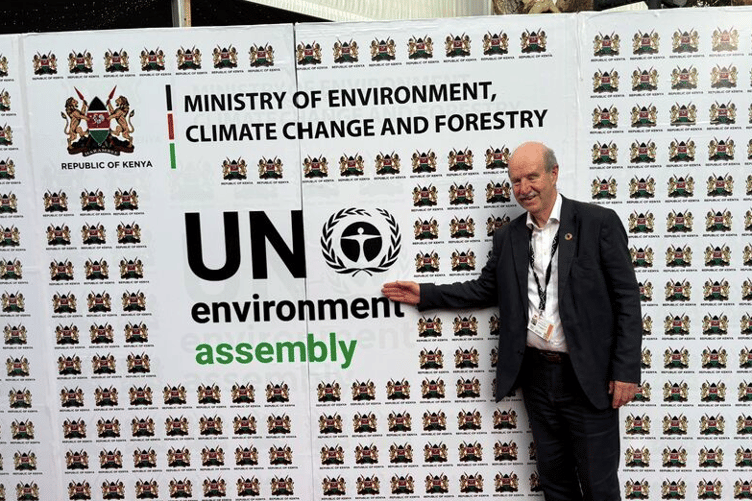
A PIONEERING climate change project led in the Forest of Dean has been recognised on the world stage after receiving international attention at the Seventh United Nations Environment Assembly in Nairobi, Kenya.
Project AURORA, which was piloted in the UK by Forest of Dean District Council, was showcased at a high-profile side event during the UN summit, marking a major success for the district’s role in tackling climate change through citizen-led action.
Funded by the European Union, AURORA was selected by an independent international panel of citizen scientists as one of just four EU-backed projects to help shape a new global citizen science programme on climate change mitigation.
The initiative is being developed by the Citizen Science Global Partnership (CSGP), which aims to put communities at the heart of climate solutions worldwide.



The recognition places the Forest of Dean alongside projects from across Europe and highlights the district’s contribution to an emerging global movement that empowers ordinary people to play an active role in reducing carbon emissions.
A detailed press pack, including the report A Global Citizen Science Programme on Climate Change Mitigation, was released at UNEA7 during a meeting of non-governmental organisations, setting out plans for how citizen science can be scaled up internationally to address the climate crisis.
Locally, Project AURORA has already delivered tangible benefits. One of its key legacies in the Forest of Dean has been the formation of the Forest Community Energy Group, alongside several community-led energy initiatives designed to cut emissions and reduce household energy use.
Central to the project is the AURORA Energy Tracker app, which allows residents to monitor their energy consumption, understand their carbon footprint, and make informed decisions to reduce their impact on the environment. The approach is designed to show how local action, driven by residents themselves, can contribute to global climate goals.
Martin Brocklehurst, the project’s communications lead and Chair of the Citizen Science Global Partnership, represented AURORA at UNEA7 and worked closely with the UK delegation during the summit. He also took part in discussions with ministers and non-state leaders at the Annual Ministerial Meeting of the Climate and Clean Air Coalition, held alongside the UN assembly.
The Forest of Dean project was highlighted in meetings involving Parliamentary Under-Secretary for Nature Mary Creagh CBE MP, as well as senior UK officials, underlining the growing recognition of citizen science as a powerful tool in climate policy.
Launched in December 2021 under the EU’s Green Deal and funded through the Horizon 2020 programme, Project AURORA received €4.6 million in investment and aims to cut greenhouse gas emissions by 50 per cent within the next decade.
Across five demonstration sites in England, Denmark, Portugal, Slovenia and Spain, the project has helped reduce the carbon footprint of around 7,000 citizens.
Unlike top-down climate initiatives, AURORA focuses on community leadership, encouraging people to become both producers and consumers of energy.
Its success in the Forest of Dean is now helping shape international thinking on how citizen-led projects can play a central role in tackling climate change.
Comments
We've recently changed our login process. If you have an account for commenting, you will need to re-register on the login window.
This article has no comments yet. Be the first to leave a comment.