

Rituals for saying goodbye to the dead have existed for thousands of years and reflect social, cultural and religious beliefs. We can learn so much about a society by studying their attitudes towards death, dying and the dead.
In an article for the current New Regard, the journal of the Forest of Dean Local History Society, Kathryn Berry, a local PhD student, explores aspects of 19th and early 20th century life – and death – through the contents of a collection rediscovery at the Dean Heritage Centre.


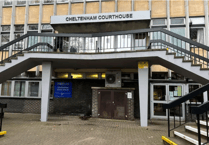


It may seem strange to readers in the 21st century, when death has become medicalised and when many choose cremation rather than burial, that our ancestors were very worried about what happened to their bodies after death.
Today many are separated from death processes: we often die in hospital, we have funeral companies who take care of the body and we go along to a funeral and walk away (possibly with a pint or two down the pub to follow).
However, for those in the later 19th century, especially in rural mining areas such as the Forest, where people were surrounded by death as well as life, they did not have the option of immediately removing the corpse to a different room, let alone a different location.
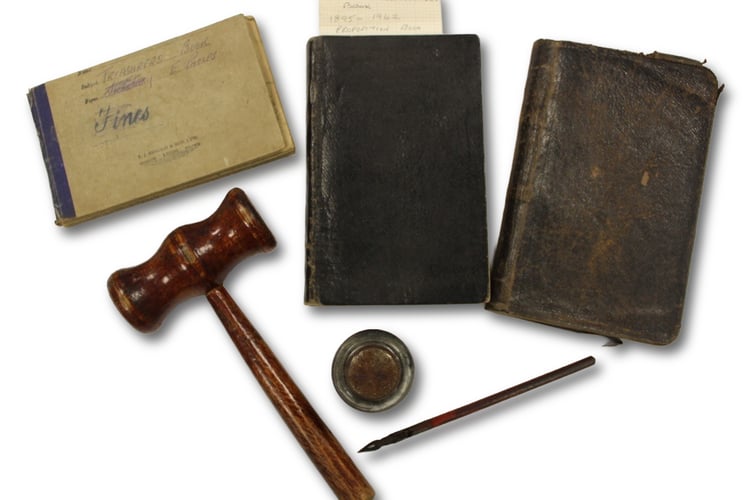
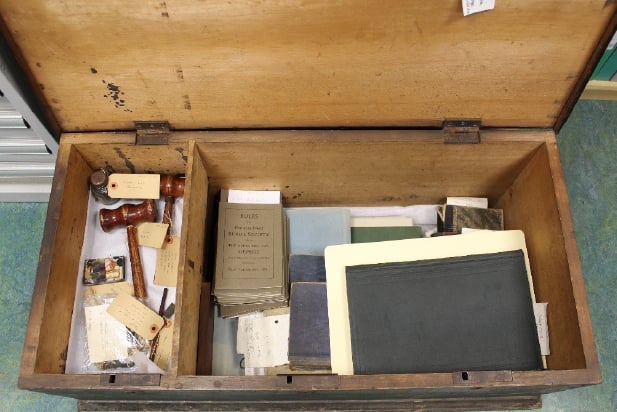
Nicola Wynn, the Dean Heritage Centre’s Collections Officer rediscovered a box in a corner of the Centre’s Gage Library. Inside were the remnants and records of the Friend in Need Burial Society, often known as a ‘Death Club’ or ‘Burial Club’. The contents of this box represent the preparations people made for death in the Forest of Dean.
Burial Clubs and Societies
Burial clubs and societies were a way to provide for a funeral and to offer financial support after death, although they often came under the auspices of a Friendly Society.
Burial clubs became popular during the 18th and 19th centuries because nobody wanted the indignity of a ‘pauper funeral’. In the 16th century it was just accepted that the poor would have a less auspicious funeral whilst the wealthy would have one that cost more money.
However, by the middle of the 18th century historian Thomas Laqueur wrote: “the funerals of the poor became pauper funerals … both terrifying to contemplate oneself and profoundly degrading to one’s survivors”.
The fear was not necessarily of death itself, nor of dying being poor, but of the burial being ‘poor’ and therefore a negative reflection on the deceased as well as the bereaved families left behind in the society.
The Anatomy Act of 1832 meant that the deceased poor faced the possibility of their cadavers being used for medical research without their consent. Where previously this had only applied to murderers and criminals, the Act extended the use of bodies to those who died without funeral provision.
Whilst the Forest itself was not a centre for medical research like the bigger cities, the fear would still exist. With workhouses such as those at Chepstow, Westbury and Newent taking in more and more paupers, there were quite a few of those suffering the indignity of pauper funerals.
The death bed
The ‘traditional’ Victorian family death of the 19th century often appears in art and literature as being that of the dying person in bed surrounded by relatives and looking calm, dignified and accepting of death. The family would linger for some time with the body and the mourning period would be one of contemplation and the receiving of visitors.
It is unlikely, however, that this would have been the case for most Forest residents with families to feed and work – often in the mines – that would not allow for them to succumb to grief for extended periods of time. The ostentatious aspects of the upper-class and middle-class Victorian funeral, with periods of mourning, somewhat inspired by Queen Victoria’s own extended mourning, would not be applicable to the everyday Forest of Dean folk. Forest mining communities prided themselves on their independence and hard work rather than their class status.
The rise of Burial Clubs and Societies in the 18th and 19th centuries was reflected in the setting up of the Friend in Need Burial Society in Ruspidge in 1894. This shows that at the time of its inception there had been a recognition of the need for a decent funeral and, by implication, a decent afterlife, whilst enabling the bereaved to be financially supported in the process.
Inequality in death
But saving up for a funeral could affect the poor, especially women. If they were in receipt of parish relief such savings could be considered an indulgence. Some Parish Relief Guardians refused relief to widows of men provident enough to have insured for their funeral expenses. In some cases the husband’s Burial Club benefits did not pass on to his widow.
The man was the priority. Preparation for old age, poverty and death was focused on the husband whilst the wife would have to hope to find employment or rely on either family, workhouse or ‘outdoor relief’. However, the benefits of the burial clubs and societies outweighed these risks and, for many, provided support and peace of mind for families whilst they prepared for the inevitability of death as well as providing assistance after death.
Club meetings
Burial Club meetings were mostly in public houses, which allowed members to come together on a regular basis and have a friendly drink whilst they discussed issues of the day alongside deaths of the month.
Nationally, the popularity of such clubs and societies is seen in the rise in membership numbers from the end of the 18th to the later 19th centuries; in 1801 there were 7,200 clubs with a membership of nearly 650,000. By 1891 membership for sickness and funeral benefits was reported to be two and a quarter million.
The growth in membership shows an interest in preparation for death and for the afterlife, that waned as attitudes towards death changed after the world wars of the 20th century.
The Friend in Need Burial Society
The Friend in Need Burial Society of the Rising Sun Inn Ruspidge was established in 1894 and closed 1985. A summary document lists doctors, overall deaths and a summary of deaths by year, name, age, occupation and cause of death. The collection includes death certificates, cash books, receipts, rule books, club cards, subscription books and writing accessories.
There is a rough pencil bar chart showing the age group of those who had died between 1896 and 1963. The occupations of the deceased are listed, with colliers and children of colliers appearing frequently, portraying the strong mining community of the Forest.
The highest amount of deaths were between birth to five years (45) but there is an element of longevity with some members living into their 80s (two). Child mortality was high but there was still a chance of living to a ‘good’ age should one survive those initial first few years.
Causes of death
The lists give us an insight into causes of death and diagnoses alongside the tragedy of infant mortality. ‘Marasmus’ appears frequently as a cause of death in babies, which means severe malnutrition and reflects the difficulties in the lives of rural colliers and their families. There are examples of several premature births, including a set of twins who died at one day and two days old. One baby died of ‘immaturity’ (presumably premature) and ‘exhaustion’ at only 20 days whilst some babies died of simply ‘debility’. ‘
Malassimilation of food’ caused the death of a five-month-old whilst ‘convulsions’ also appeared quite frequently as a cause of death for many babies and toddlers, one child suffering these due to ‘teething’. Measles also caused some deaths for the young alongside death due to pneumonia; occasionally both measles and pneumonia were causes of death in the same instance.
Another cause seen more than once in the death of babies is ‘enteritis’, which reflects the poor living conditions where stomach issues and parasitic problems were often an issue. The risk of fire in homes that were heated by open hearths is seen – one nine-year-old coal-miner’s daughter was burnt to death, her clothes catching fire as they were burning a pig.
Open water for mining shafts as well as local brooks, ponds and streams also presented a danger for the Forest of Dean young and in the list is a six-year-old boy who drowned having fallen into a place labelled ‘Yellow Shaft Pond’ and a five-year-old girl who died in Soudley Brook.
One 46-year-old coal hewer died from drowning ‘while suffering from melancholy’, which implies that the cause of death was by suicide although the description does not use that word. This avoidance was possibly due to attitudes towards suicide at the time of death, both in terms of religious and cultural beliefs, beliefs that could even impact on the burial itself.
‘Phthisis’ (tuberculosis) took the life of 46-year-old lady, the doctor adding the further description of tuberculosis with the word ‘consumption’. Alongside another example of tuberculosis there are also several deaths due to breathing and lung issues, which could reflect the prevalence of coal dust alongside the difficulties of rural homes such as lack of heating and presence of damp.
There is quite a prevalence of death due to issues with the heart: ‘syncope’ implying blood pressure problems, ‘cardiac disease’, ‘oedema’, ‘dilation of heart’, ‘cardio-vascular degeneration’, ‘cardiac failure’, ‘myocarditis’ (inflammation of the heart muscle) amongst other examples.
Two of the deaths were colliery fatalities, one at Lightmoor and one at Eastern United, but many of the deaths seen in the list could also be attributed to working in a job that meant exposure to coal dust, cramped and damp conditions and excessively long working hours.
The collection gives a snapshot of what life was like for everyday folk in the Forest of Dean in the late 19th century and early 20th century. At its most active in the earlier years, the Friend in Need Burial Society provided a service to the community of Ruspidge and further afield.
Without such clubs and societies many of the poorest members of the community would not have been able to prepare for their deaths and their families would not have had the financial support needed whilst at their most vulnerable, bereaved and wanting to give their loved ones a ‘good’ burial.
By the latter end of the 20th century the burial society was overtaken by a range of new life insurance policies available on the market, ones that didn’t have so many stringent rules about attendance and behaviours.
Nicola Wyns adds: “This collection is a fantastic rediscovery. It gives a fascinating insight into the social history of the Forest of Dean in the late 19th to 20th century, particularly in relation to health and welfare pre-NHS. We would like to know more about the collection; if anyone knows anything about the burial club please get in contact with me at the Dean Heritage Centre.”
For copies of the New Regard check out the web site of the Forest of Dean Local History Society or local book sellers such as the Dean Heritage Centre.
Comments
We've recently changed our login process. If you have an account for commenting, you will need to re-register on the login window.
This article has no comments yet. Be the first to leave a comment.