

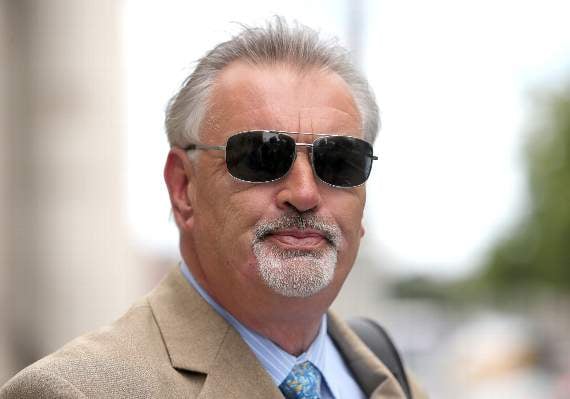
THE family of a French filmmaker who was murdered outside her Irish clifftop cottage 24 years says it will continue its battle to make a former Forest journalist serve a 25-year jail term for the killing.
The Irish Minister of Justice said last week he won’t be appealing last month’s Dublin High Court ruling rejecting the extradition of Ian Bailey to France on a European Arrest Warrant (EAW).
Mr Bailey, aged 63, who used to live near Newent, has always denied any involvement in Sophie Toscan du Plantier’s death and has never been charged with the killing by Irish police.
A Paris court found the British citizen guilty of murder in his absence last year, but Irish courts and authorities have consistently refused to extradite him.



The family of mother-of-one Ms du Plantier, who was the wife of the Paris Film Festival director and a friend of President Mitterand, expressed “huge disappointment” at the Irish State’s decision not to appeal the warrant ruling on behalf of the French authorities.
And they say they will be raising the matter with the European Union and are considering an approach to French leader Emmanuel Macron to raise the case with Irish Taoiseach Micheal Martin.
Mr Justice Burns ordered last week that Mr Bailey, who has lived with Welsh partner Jules Thomas on the Cork Riviera near the murder scene for some 30 years, can recover his legal costs from the State.
Ms Toscan du Plantier’s family requested a copy of the judge’s ruling, which he agreed should be made available to the family and the French authorities.
The judge previously ruled that the EAW didn’t extend to a non-French citizen in another country. He also said that previous extradition refusals were in Mr Bailey’s favour.
Ms du Plantier, 39, was found battered to death in her nightclothes outside her isolated holiday home just two days before Christmas 1996.
Mr Bailey was the first journalist on the scene later that day and filed stories about the killing to Irish and French newspapers.
He and Ms Thomas, who took photos of the scene for newspapers, were both arrested during the investigation but were released without any charges.
Mr Bailey slammed last year’s three-day court hearing in Paris as a “show trial” which had accepted a “bundle of lies”.
Pressed by Ms Toscan Du Plantier’s family, French authorities took up the case in 2008, leading to the 2019 trial in France which just two Irish witnesses attended.
Convicting him in 18 months ago, Judge Frederique Aline said there was “significant evidence” of Mr Bailey’s guilt.
The French court was told of scratches seen on his hands and forehead on December 23, the day Ms Toscan du Plantier’s body was found.
He said they were from killing and plucking three turkeys and cutting down a Christmas tree, but the Paris court heard that witnesses had seen him playing a bodhran drum in the pub the night before with rolled-up sleeves and observed no scratches.
Bill Fuller – one of the two Irish witnesses to give live evidence – said Mr Bailey had recounted a scenario of the killing to him.
He claimed he said: “You did it… you saw her in Spar and she got you excited as she walked through the aisles
“You went to her place to see what you could get, but she wasn’t interested so you attacked her.
“She tried to escape and you ran after her.
“You threw something at the back of her head and you went further than you planned to.”
But Mr Bailey, who refused to attend the trial, said after the Paris court passed a 25-year jail term: “I know there are people in this country who know that it was not me that was the culprit… my prayer has been that the truth will come out.”
Comments
This article has no comments yet. Be the first to leave a comment.