
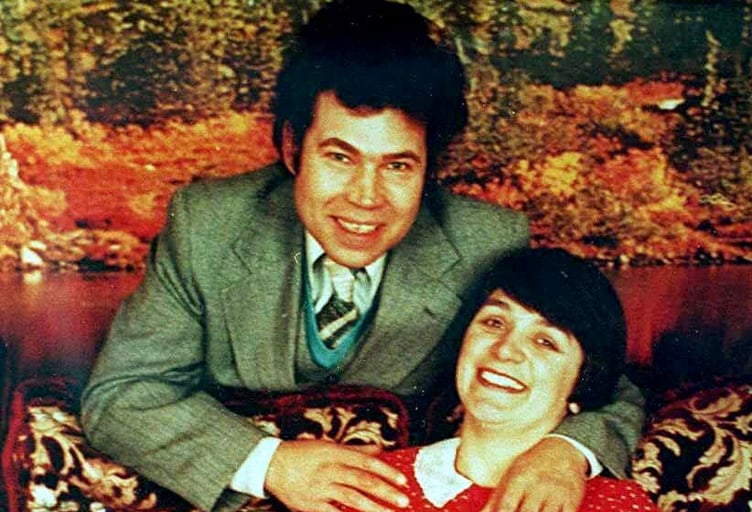
POTENTIAL new grave sites possibly used by Gloucestershire serial killer Fred West have been found on a field close to where two of his victims were discovered.
Investigators carried out an experimental drone survey on an area where Fred’s first wife Rena West and the remains of Anna McFall were discovered.
West, who grew up in Much Marcle, was known to use the Fingerpost and Letterbox fields in the village as a young man.
Suspicion first arose of additional victims being buried there when a Trevor McDonald documentary in 2022 found six potential sites of interest using ground radar technology.
Results of the experimental drone survey have now confirmed two matching anomalies linked to the radar and a potential additional seventh burial site.
The results have led to fresh calls for police and forensic investigators to excavate the area in the hope of providing answers to families of some of the missing girls linked to the serial killer.
West was charged with 12 murders, but took his own life in prison in 1995, aged 53, before his trial.
His wife Rose West was convicted of 10 murders in November 1995 and is serving a life sentence.
One of the victims, whose body was found buried under the floor of their 25 Cromwell Street house in Gloucester, was Juanita Mott, aged 19, from Newent.
But it is widely believed Fred was responsible for several more deaths – but took any secrets to his grave.



Tim Whittard, of Gloucester, who helped organise the drone survey, said they focused on the boundary between the Fingerpost Field, where Anna’s was found, and Letterbox Field, where Rena was recovered.
He said: “We used entirely different technology to the documentary that seemed to corroborate two of the six sites, and possibly identified a seventh.
“This has to be looked at. We’ve got pretty solid evidence that Fred used the fields regularly and two bodies were found nearby.
“It is a proverbial needle in a haystack but technology provides a shortcut. You are not going to have to go over every square inch of the field.
“We used the drone to look into a very small area and it was experimental.
“But we were very shocked by the anomalies in the soil. This can not be picked up by the naked eye and you wouldn’t see them stood next to them.
“I did not really think we would find much but we were looking to corroborate some of the sites using different technology.
“We had no real hopes when started.
“But we all got very emotional when we were doing it. If we can find even one missing girl it is worth it and that was a sentiment we all shared.”
Tim said the findings should be taken seriously and a proper and full excavation should now follow.
He added: “Those girls are still missing. They are someone’s sister, girlfriend, daughter.
“Sure it was a long time ago and a lot of their close loved ones will have left the world without knowing. I still don’t think that is a good enough reason to give up looking.
“That is the excuse you seem to hear. It might have been a long time ago but you don’t obliterate it from your mind. You have to continue to try and solve these mysteries.
“I know it is a hot potato and I have some sympathy for when people say can you not leave it to rest, but I also have a deep sympathy for people who want answers.”
Tim said his team’s drone used multispectral cameras and advanced software, called DroneDeploy, to shed further light on the research done for the ITV documentary ‘Fred and Rose: Reopened’.
He added: “Our drone survey using entirely different technology appears to have corroborated the two anomalies pick up by GPR which were inside our drone’s search area, and possibly identified a seventh.
“Of the three anomalies we identified, the one furthest from the road appears to be of greatest interest.
“On the graphics you can see the different undulations in the surface. It looks like it just pops out.
“Most research that has been done has targeted Fingerpost field and we know Fred favoured burying victims around the perimeters of the two fields.
“That is about as much as you can profile his behaviour. We focused on the boundary between the two fields, killing two birds with one stone.
“There were depressions in the soil that seemed to be consistent with the size and dimensions of a burial site.”
He added: “It may be easy to dismiss but the fact it is in the same area as the radar makes it more interesting.
“The one furthest from the road was so pronounced and further away from any trees, there is a gut feeling there is something there. That tells me this one should be prioritised for an excavation.
“It is a pronounced rectangular shape and matches accurate ground penetration radar.
“It is not even a metre deep. A good man with a shovel could get to the bottom of this in an hour. You would obviously need a forensic archaeologist on hand once they’ve dug deep enough.”
Tim said even more advanced drone technology could also be deployed to help solve the mystery.
He added: “There are three potential bodies there and the least that can be done is for all the technology used to find out.
“My feeling is there are still missing girls and it does not matter how long ago it was. It needs the authorities with a bigger budget and a bigger drone.
“We have highlighted three in just the area we surveyed. There are another four with ground penetration radar nearby.
“There is a chance some could be false positives but even if just one of them turned out to be a grave it is worth checking on them all.”
Tim said that as a local Gloucester resident and investigator he has always followed the case closely and hoped a breakthrough could come soon.
He added: “The person who owns the land has always been very cooperative. The police probably don’t want to touch it with a bargepole as it could open a big can of worms.
“But there is a lot of learning to do and behaviours of serial killers. Understanding what Fred did can be very important.”
Comments
We've recently changed our login process. If you have an account for commenting, you will need to re-register on the login window.
This article has no comments yet. Be the first to leave a comment.