
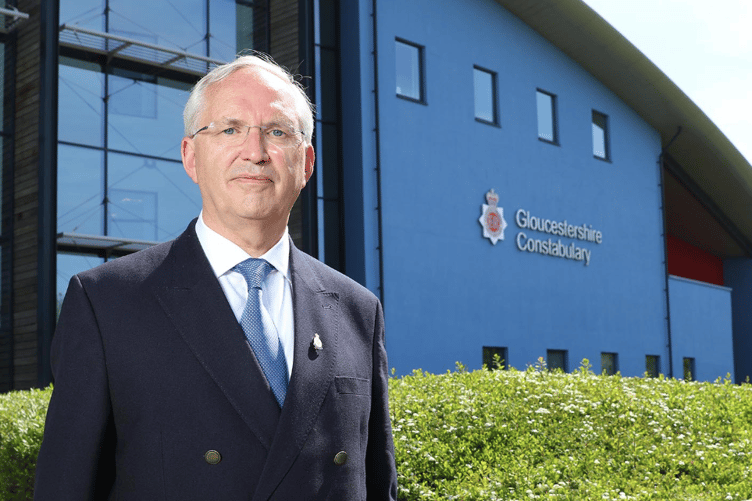
GLOUCESTERSHIRE'S police and crime commissioner has warned against rushing into a merger with another force, saying the potential financial benefits must be carefully weighed against the risks involved.
Chris Nelson has acknowledged that joining forces with a neighbouring area could improve resilience but believes any reorganisation needs careful consideration.
The Government is examining plans to replace the existing structure of 43 police forces in England and Wales with larger regional organisations, alongside a new national policing service.
Gloucestershire is among the smallest forces and has faced significant pressure on its budget, prompting renewed debate about whether remaining independent is sustainable.
Mr Nelson has previously said that the financial difficulties of smaller forces can be particularly severe because they lack the resources and specialist capacity available to larger organisations.
However, he has cautioned against merging forces simply for the sake of creating bigger organisations.
Speaking about reform earlier this autumn, the commissioner said changes had to be made in the right way, rather than pursuing a merger at any cost.
The debate is particularly relevant to communities in the Forest of Dean, where policing covers scattered villages, market towns and roads crossing county and national borders.
Residents will want reassurance that neighbourhood officers, response times and the ability to tackle rural crime are protected if major organisational changes go ahead.
Gloucestershire's temporary chief constable Maggie Blyth has expressed support for reform, arguing that greater coordination could reduce the cost of equipment, technology and other services.



She has said she expects local policing to continue in Gloucestershire even if larger regional forces are created.
The constabulary has reported removing an average of £14.5 million from its organisation over the past three years as it responds to financial pressures.
A recent inspection also identified weaknesses in several areas, including crime investigations and leadership, while calling for improvements to public response and safeguarding.
Police leaders say changes already underway are intended to improve performance, but they believe additional government investment is necessary.
Earlier this year, reports suggested Gloucestershire and Wiltshire could become part of the same regional policing structure.
No final merger arrangement has been confirmed, and an independent review is expected to help determine how any new force boundaries might be drawn.
Mr Nelson has also raised concerns about accountability as wider reforms could replace elected police and crime commissioners with alternative oversight arrangements.
The commissioner is responsible for setting policing priorities, overseeing the budget and holding the chief constable to account, rather than directing individual operations.
Supporters of mergers argue centralising specialist services could release resources, while critics question whether local priorities might be diluted.
Any structural changes could therefore affect not only the organisation of the force but also the way residents raise concerns about policing in their communities.
For the Forest, questions remain about how resources would be allocated between rural and urban areas within a much larger organisation.
Police leaders are awaiting further government announcements, expected later this month, before the possible shape and timetable of reform become clearer.
Comments
We've recently changed our login process. If you have an account for commenting, you will need to re-register on the login window.
This article has no comments yet. Be the first to leave a comment.